Tetris 1.0
Note
🌟 Welcome to the SunFounder Facebook Community! Whether you’re into Raspberry Pi, Arduino, or ESP32, you’ll find inspiration, help ideas here.
✅ Be the first to get free learning resources.
✅ Stay updated on new products & exclusive giveaways.
✅ Share your creations and get real feedback.
👉 Need faster updates or support? Click [here] join our Facebook community
👉 Or join our WhatsApp group: Click [here]
🎁 Looking for parts?Check out our all-in-one kits below — packed with components, beginner-friendly guides, and tons of fun.
Name |
Includes Arduino board |
PURCHASE LINK |
|---|---|---|
Elite Explorer Kit |
Arduino Uno R4 WiFi |
|
3 in 1 Ultimate Starter Kit |
Arduino Uno R4 Minima |
Course Introduction
In this project, we use a MAX7219 8x8 Dot Matrix module, a joystick, and an Arduino board to play a classic Tetris game.
The falling blocks are controlled using the joystick for left, right, down, and rotation.
Note
If this is your first time working with an Arduino project, we recommend downloading and reviewing the basic materials first.
Required Components
In this project, we need the following components:
SN |
COMPONENT INTRODUCTION |
QUANTITY |
PURCHASE LINK |
|---|---|---|---|
1 |
Arduino UNO R4 Minima |
1 |
|
2 |
USB Type-C cable |
1 |
|
3 |
Breadboard |
1 |
|
4 |
Wires |
Several |
|
5 |
Joystick Module |
1 |
|
6 |
MAX7219 Dot Matrix Module |
1 |
Wiring
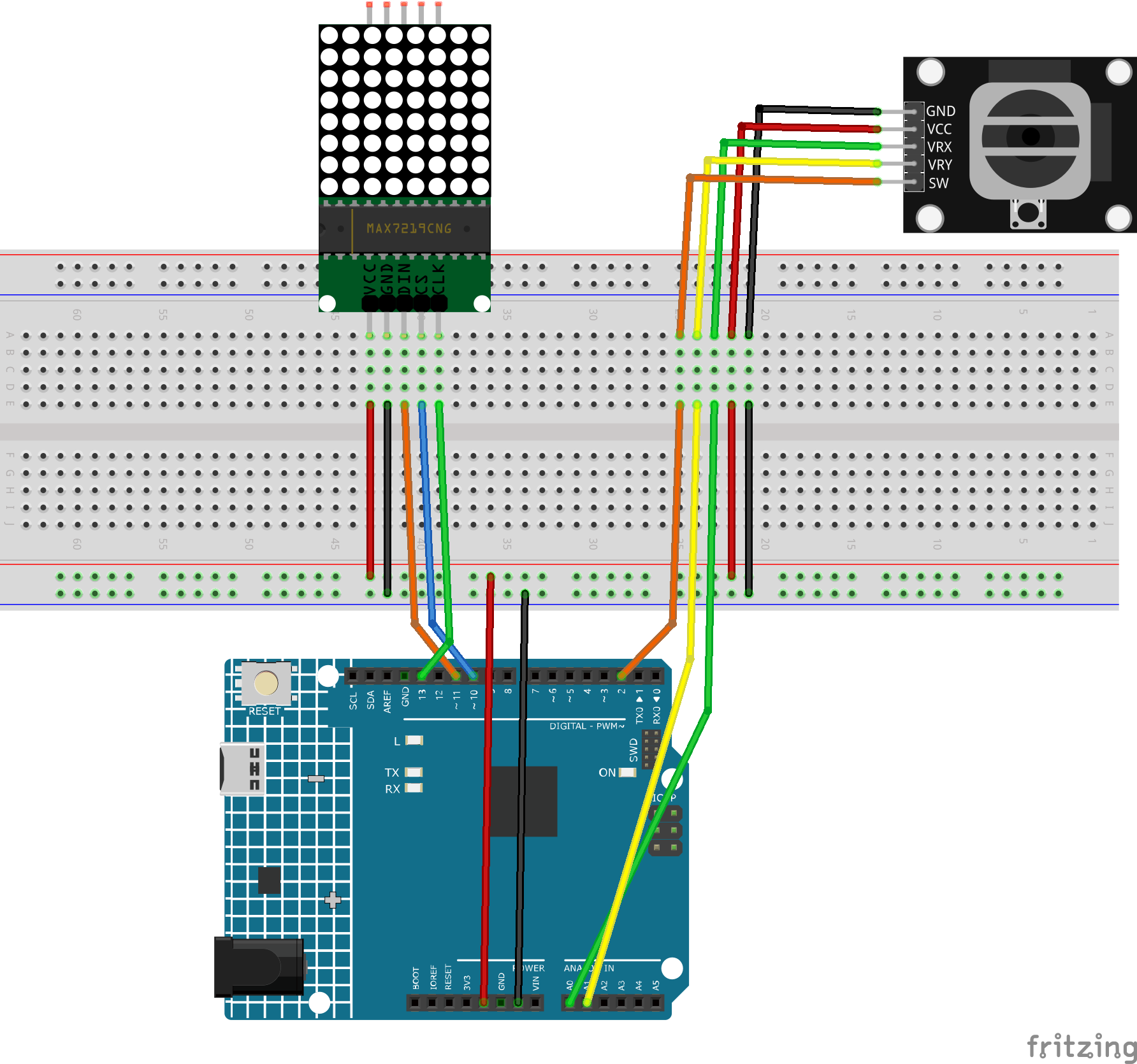
Common Connections:
MAX7219 Dot Matrix Module
CLK: Connect to 13 on the Arduino.
CS: Connect to 10 on the Arduino.
DIN: Connect to 11 on the Arduino.
GND: Connect to breadboard’s negative power bus.
VCC: Connect to breadboard’s red power bus.
Joystick Module
SW: Connect to 2 on the Arduino.
VRY: Connect to A1 on the Arduino.
VRX: Connect to A0 on the Arduino.
GND: Connect to breadboard’s negative power bus.
VCC: Connect to breadboard’s red power bus.
Writing the Code
Note
You can copy this code into Arduino IDE.
To install the library, use the Arduino Library Manager and search for LedControl and install it.
Don’t forget to select the board(Arduino UNO R4 WIFI) and the correct port before clicking the Upload button.
// Arduino Tetris Game for 8x8 MAX7219 + Joystick
#include <LedControl.h>

#define DIN 11
#define CS 10
#define CLK 13
LedControl lc = LedControl(DIN, CLK, CS, 1);

#define VRx A0
#define VRy A1
#define SW  2

byte field[8];  // 8 rows (height), 8 columns (width)
int score = 0;

struct Block {
  const int (*shape)[2];
  int len;
  int x, y;
  int rotation;
  char type;
};

// Block definitions with all rotations
const int I[2][4][2] = {{{0,0},{0,1},{0,2},{0,3}}, {{-1,1},{0,1},{1,1},{2,1}}};
const int O[1][4][2] = {{{0,0},{1,0},{0,1},{1,1}}};
const int T[4][4][2] = {{{1,0},{0,1},{1,1},{2,1}}, {{1,0},{1,1},{1,2},{0,1}}, {{0,1},{1,1},{2,1},{1,2}}, {{1,0},{1,1},{1,2},{2,1}}};
const int L[4][4][2] = {{{0,0},{0,1},{0,2},{1,2}}, {{0,0},{1,0},{2,0},{0,1}}, {{0,0},{1,0},{1,1},{1,2}}, {{2,0},{0,1},{1,1},{2,1}}};
const int J[4][4][2] = {{{1,0},{1,1},{1,2},{0,2}}, {{0,0},{0,1},{1,1},{2,1}}, {{0,0},{1,0},{0,1},{0,2}}, {{0,0},{1,0},{2,0},{2,1}}};
const int S[2][4][2] = {{{1,0},{2,0},{0,1},{1,1}}, {{1,0},{1,1},{2,1},{2,2}}};
const int Z[2][4][2] = {{{0,0},{1,0},{1,1},{2,1}}, {{2,0},{1,1},{2,1},{1,2}}};

Block current;
unsigned long lastDrop = 0;
unsigned long dropInterval = 500;
bool gameRunning = false;

void setup() {
  lc.shutdown(0, false);
  lc.setIntensity(0, 8);
  lc.clearDisplay(0);
  pinMode(SW, INPUT_PULLUP);
  randomSeed(analogRead(0));
}

void loop() {
  if (!gameRunning && digitalRead(SW) == LOW) {
    resetGame();
    spawnBlock();
    gameRunning = true;
  }

  if (gameRunning) {
    handleInput();
    if (millis() - lastDrop > dropInterval) {
      if (!moveBlock(0, 1)) {
        placeBlock();
        clearLines();
        spawnBlock();
      }
      lastDrop = millis();
    }
    draw();
  }
}

void resetGame() {
  for (int i = 0; i < 8; i++) field[i] = 0;
  score = 0;
}

void spawnBlock() {
  int r = random(7);
  switch (r) {
    case 0: current = {I[0], 4, 3, 0, 0, 'I'}; break;
    case 1: current = {O[0], 4, 3, 0, 0, 'O'}; break;
    case 2: current = {T[0], 4, 3, 0, 0, 'T'}; break;
    case 3: current = {L[0], 4, 3, 0, 0, 'L'}; break;
    case 4: current = {J[0], 4, 3, 0, 0, 'J'}; break;
    case 5: current = {S[0], 4, 3, 0, 0, 'S'}; break;
    case 6: current = {Z[0], 4, 3, 0, 0, 'Z'}; break;
  }
  if (checkCollision(current.x, current.y)) gameOver();
}

void handleInput() {
  int x = analogRead(VRx);
  int y = analogRead(VRy);

  if (x < 400) {
    moveBlock(1, 0);
    delay(150);
  }
  else if (x > 600) {
    moveBlock(-1, 0);
    delay(150);
  }

  dropInterval = 700 - constrain(map(y, 512, 1023, 0, 600), 0, 600);

  if (digitalRead(SW) == LOW) {
    rotateBlock();
    delay(200);
  }
}

bool moveBlock(int dx, int dy) {
  if (!checkCollision(current.x + dx, current.y + dy)) {
    current.x += dx;
    current.y += dy;
    return true;
  }
  return false;
}

bool checkCollision(int x, int y) {
  for (int i = 0; i < current.len; i++) {
    int px = x + current.shape[i][0];
    int py = y + current.shape[i][1];
    if (px < 0 || px >= 8 || py < 0 || py >= 8) return true;
    if (field[py] & (1 << px)) return true;
  }
  return false;
}

void placeBlock() {
  for (int i = 0; i < current.len; i++) {
    int px = current.x + current.shape[i][0];
    int py = current.y + current.shape[i][1];
    if (px >= 0 && px < 8 && py >= 0 && py < 8)
      field[py] |= (1 << px);
  }
}

void clearLines() {
  for (int y = 0; y < 8; y++) {
    if (field[y] == 0xFF) {
      for (int j = y; j > 0; j--) field[j] = field[j - 1];
      field[0] = 0;
      score += 10;
    }
  }
}

void gameOver() {
  for (int i = 0; i < 6; i++) {
    for (int y = 0; y < 8; y++) {
      for (int x = 0; x < 8; x++) {
        bool ledOn = (i % 2 == 0) && (field[y] & (1 << x));
        lc.setLed(0, y, x, ledOn);
      }
    }
    delay(300);
  }
  gameRunning = false;
}

void draw() {
  for (int y = 0; y < 8; y++) {
    byte row = field[y];
    for (int i = 0; i < current.len; i++) {
      int px = current.x + current.shape[i][0];
      int py = current.y + current.shape[i][1];
      if (py == y && px >= 0 && px < 8)
        row |= (1 << px);
    }
    lc.setRow(0, y, row);
  }
}

void rotateBlock() {
  int nextRot = current.rotation + 1;
  int maxRot = 1;
  const int (*nextShape)[2];

  switch (current.type) {
    case 'I': maxRot = 2; nextShape = I[nextRot % maxRot]; break;
    case 'O': return;
    case 'T': maxRot = 4; nextShape = T[nextRot % maxRot]; break;
    case 'L': maxRot = 4; nextShape = L[nextRot % maxRot]; break;
    case 'J': maxRot = 4; nextShape = J[nextRot % maxRot]; break;
    case 'S': maxRot = 2; nextShape = S[nextRot % maxRot]; break;
    case 'Z': maxRot = 2; nextShape = Z[nextRot % maxRot]; break;
    default: return;
  }

  const int (*oldShape)[2] = current.shape;
  int oldRot = current.rotation;
  current.shape = nextShape;
  current.rotation = nextRot % maxRot;

  if (checkCollision(current.x, current.y)) {
    current.shape = oldShape;
    current.rotation = oldRot;
  }
}