TempHumid Monitor
Note
🌟 Welcome to the SunFounder Facebook Community! Whether you’re into Raspberry Pi, Arduino, or ESP32, you’ll find inspiration, help ideas here.
✅ Be the first to get free learning resources.
✅ Stay updated on new products & exclusive giveaways.
✅ Share your creations and get real feedback.
Kit purchase
Looking for parts? Check out our all-in-one kits below — packed with components, beginner-friendly guides, and tons of fun.

Name |
Includes Arduino board |
PURCHASE LINK |
|---|---|---|
Elite Explorer Kit |
Arduino Uno R4 WiFi |
|
3 in 1 Ultimate Starter Kit |
Arduino Uno R4 Minima |
Course Introduction
This Arduino project uses a DHT11 sensor and an OLED display to monitor and display real-time temperature and humidity.
The data is updated every 0.5 seconds and shown clearly on a 128x64 I2C OLED screen. If sensor readings fail, an error message is displayed.
This setup is ideal for simple environmental monitoring applications.
Note
If this is your first time working with an Arduino project, we recommend downloading and reviewing the basic materials first.
Required Components
In this project, we need the following components:
SN |
COMPONENT INTRODUCTION |
QUANTITY |
PURCHASE LINK |
|---|---|---|---|
1 |
Arduino UNO R4 WIFI |
1 |
|
2 |
USB Type-C cable |
1 |
|
3 |
Breadboard |
1 |
|
4 |
Wires |
Several |
|
5 |
DHT-11 Module |
1 |
|
6 |
OLED Display Module |
1 |
Wiring
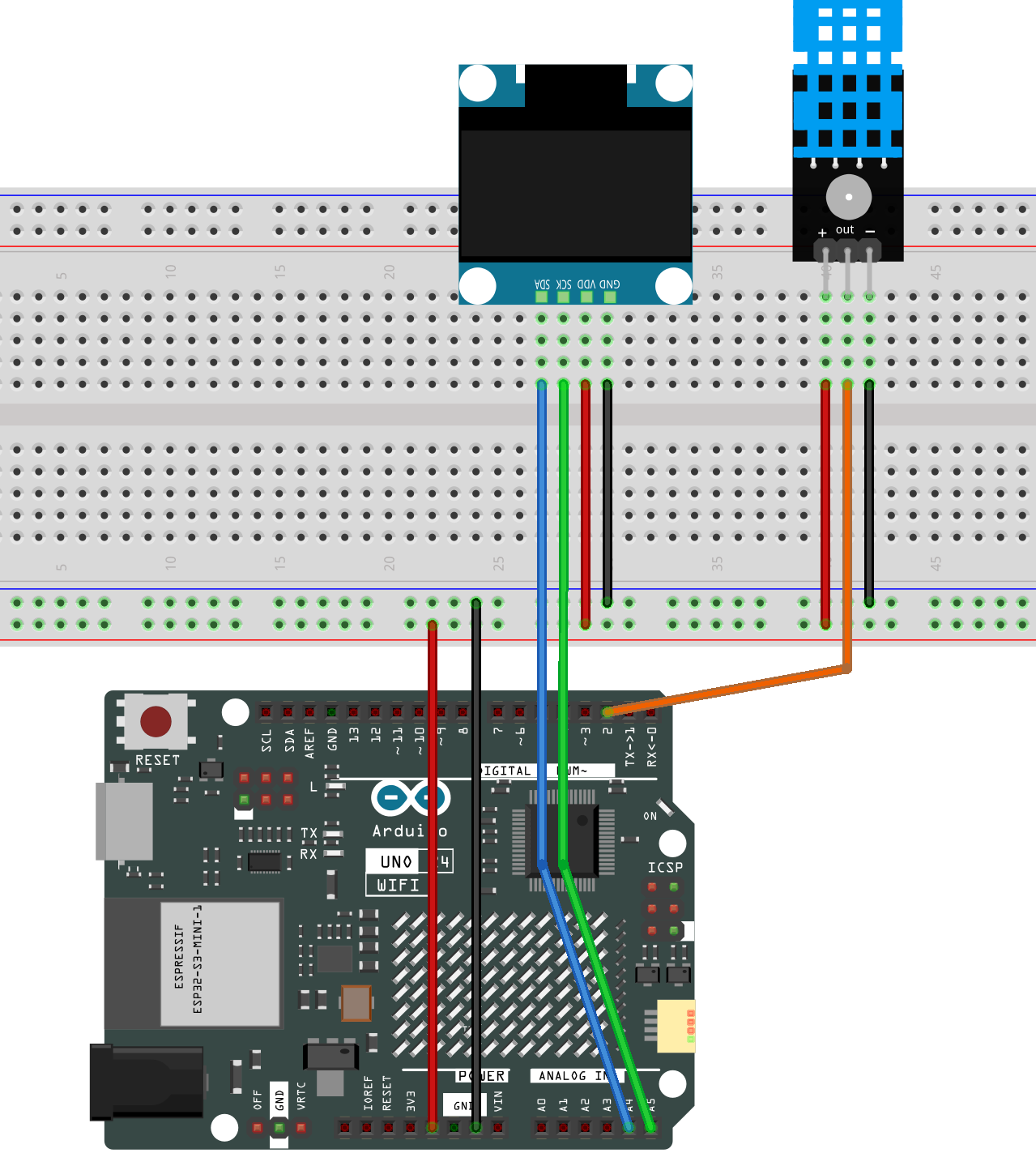
Common Connections:
DHT-11 Module
OUT: Connect to 2 on the Arduino.
-: Connect to breadboard’s negative power bus.
+: Connect to breadboard’s red power bus.
OLED Display Module
SDA: Connect to SDA on the Arduino.
SCK: Connect to SCL on the Arduino.
GND: Connect to breadboard’s negative power bus.
VCC: Connect to breadboard’s red power bus.
Writing the Code
Note
You can copy this code into Arduino IDE.
To install the library, use the Arduino Library Manager and search for DHT , Adafruit SSD1306 and Adafruit GFX and install it.
Don’t forget to select the board(Arduino UNO R4 Minima) and the correct port before clicking the Upload button.
#include <DHT.h>
#include <SPI.h>
#include <Wire.h>
#include <Adafruit_GFX.h>
#include <Adafruit_SSD1306.h>

#define SCREEN_WIDTH 128  // OLED display width, in pixels
#define SCREEN_HEIGHT 64  // OLED display height, in pixels

// Declaration for SSD1306 display connected using I2C
#define OLED_RESET -1  // Reset pin # (or -1 if sharing Arduino reset pin)
#define SCREEN_ADDRESS 0x3C
Adafruit_SSD1306 display(SCREEN_WIDTH, SCREEN_HEIGHT, &Wire, OLED_RESET);

// DHT sensor settings
#define DHTPIN 2      // Define the pin used to connect the sensor
#define DHTTYPE DHT11  // Define the sensor type
DHT dht(DHTPIN, DHTTYPE);  // Create a DHT object

void setup() {
  // Initialize the serial communication
  Serial.begin(9600);
  Serial.println(F("DHT11 with OLED test!"));

  // Initialize the DHT sensor
  dht.begin();

  // Initialize the OLED object
  if (!display.begin(SSD1306_SWITCHCAPVCC, SCREEN_ADDRESS)) {
    Serial.println(F("SSD1306 allocation failed"));
    for (;;)
      ;
  }

  // Clear the buffer.
  display.clearDisplay();
}

void loop() {
  // Wait a shorter time between measurements to increase the update speed
  delay(500);  // 500 milliseconds delay for faster updates

  // Reading temperature or humidity takes about 250 milliseconds!
  float h = dht.readHumidity();
  // Read temperature as Celsius (the default)
  float t = dht.readTemperature();

  // Check if any reads failed and exit early (to try again).
  if (isnan(h) || isnan(t)) {
    Serial.println(F("Failed to read from DHT sensor!"));
    display.clearDisplay();
    display.setCursor(0, 0);
    display.setTextSize(1);
    display.setTextColor(WHITE);
    display.println("Sensor error");
    display.display();
    return;
  }

  // Clear the display before showing new data
  display.clearDisplay();

  // Display humidity label on the first line
  display.setTextSize(1);  // Smaller text size for label
  display.setTextColor(WHITE);  // Set text color
  display.setCursor(0, 0);  // Set cursor position for humidity label
  display.println("Humidity:");

  // Display humidity value on the second line
  display.setTextSize(2);  // Larger text size for value
  display.setCursor(0, 10);  // Move to next line for humidity value
  display.print(h);
  display.println("%");

  // Display temperature label on the third line
  display.setTextSize(1);  // Smaller text size for label
  display.setCursor(0, 35);  // Set cursor position for temperature label
  display.println("Temperature:");

  // Display temperature value on the fourth line
  display.setTextSize(2);  // Larger text size for value
  display.setCursor(0, 45);  // Move to next line for temperature value
  display.print(t);
  display.println("C");

  // Update the display with new information
  display.display();

  // Also print to serial monitor (for debugging)
  Serial.print(F("Humidity: "));
  Serial.print(h);
  Serial.print(F("%  Temperature: "));
  Serial.print(t);
  Serial.println(F("°C"));
}