Accel3D
Note
🌟 Welcome to the SunFounder Facebook Community! Whether you’re into Raspberry Pi, Arduino, or ESP32, you’ll find inspiration, help ideas here.
✅ Be the first to get free learning resources.
✅ Stay updated on new products & exclusive giveaways.
✅ Share your creations and get real feedback.
Kit purchase
Looking for parts? Check out our all-in-one kits below — packed with components, beginner-friendly guides, and tons of fun.

Name |
Includes Arduino board |
PURCHASE LINK |
|---|---|---|
Ultimate Sensor Kit |
Arduino Uno R4 Minima |
|
Elite Explorer Kit |
Arduino Uno R4 WiFi |
|
3 in 1 Ultimate Starter Kit |
Arduino Uno R4 Minima |
|
Universal Maker Sensor Kit |
× |
Course Introduction
In this lesson, you’ll use an MPU6050 motion sensor, an OLED display, and a button with the Arduino to create an interactive 3D shape viewer.
By tilting the device, you can monitor live accelerometer data and watch a cube or pyramid rotate on the screen. Pressing the button switches between the two shapes, while real-time plots display X and Y acceleration values for visual feedback.
Note
If this is your first time working with an Arduino project, we recommend downloading and reviewing the basic materials first.
Required Components
In this project, we need the following components:
SN |
COMPONENT INTRODUCTION |
QUANTITY |
PURCHASE LINK |
|---|---|---|---|
1 |
Arduino UNO R4 Minima |
1 |
|
2 |
USB Type-C cable |
1 |
|
3 |
Breadboard |
1 |
|
4 |
Wires |
Several |
|
5 |
Button |
1 |
|
6 |
OLED Display Module |
1 |
|
7 |
MPU6050 Module |
1 |
Wiring
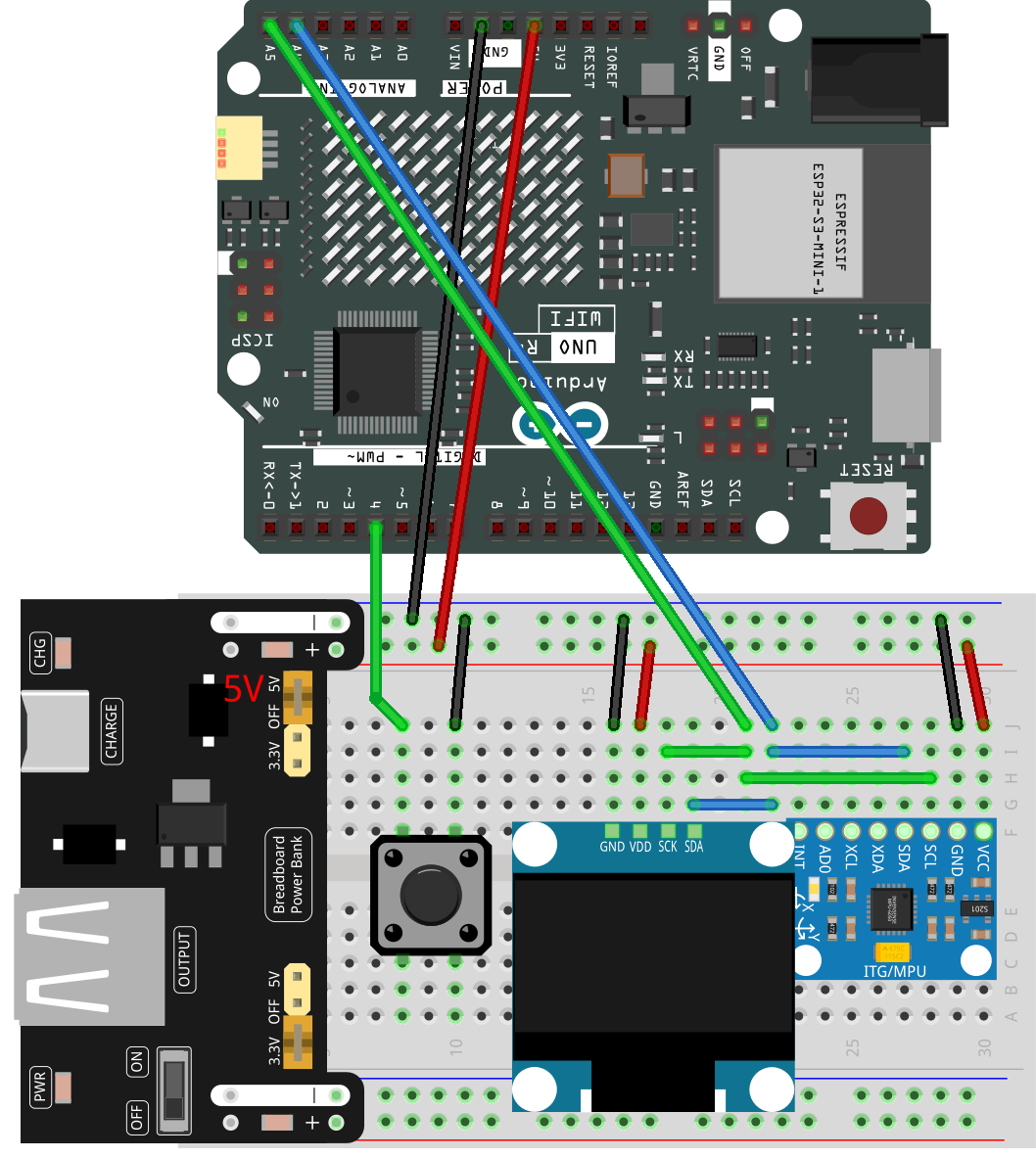
Common Connections:
OLED Display Module
SDA: Connect to A4 on the Arduino.
SCK: Connect to A5 on the Arduino.
GND: Connect to breadboard’s negative power bus.
VCC: Connect to breadboard’s red power bus.
Button
Connect to the breadboard’s negative power bus, and the other end to 4 on the Arduino board.
MPU6050
SDA: Connect to A4 on the Arduino.
SCL: Connect to A5 on the Arduino.
GND: Connect to breadboard’s negative power bus.
VCC: Connect to breadboard’s red power bus.
Writing the Code
Note
You can copy this code into Arduino IDE.
To install the library, use the Arduino Library Manager and search for Adafruit SSD1306 and Adafruit GFX and MPU6050 and install it.
Don’t forget to select the board(Arduino UNO R4 Minima) and the correct port before clicking the Upload button.
#include <Wire.h>
#include <Adafruit_GFX.h>
#include <Adafruit_SSD1306.h>
#include <Adafruit_MPU6050.h>

#define SCREEN_WIDTH 128
#define SCREEN_HEIGHT 64
#define OLED_RESET -1
#define BUTTON_PIN 4

Adafruit_SSD1306 display(SCREEN_WIDTH, SCREEN_HEIGHT, &Wire, OLED_RESET);
Adafruit_MPU6050 mpu;

bool isCube = true;
bool lastButtonState = HIGH;

float ax, ay, az;

#define PLOT_START_X 90
int plotDataX[SCREEN_WIDTH - PLOT_START_X];
int plotDataY[SCREEN_WIDTH - PLOT_START_X];

const int cubePoints[8][3] = {
  {-15, -15, -15}, {15, -15, -15}, {15, 15, -15}, {-15, 15, -15},
  {-15, -15, 15}, {15, -15, 15}, {15, 15, 15}, {-15, 15, 15}
};

const int pyramidPoints[5][3] = {
  {0, -20, 0},
  {15, 15, -15},
  {15, 15, 15},
  {-15, 15, 15},
  {-15, 15, -15}
};

void setup() {
  pinMode(BUTTON_PIN, INPUT_PULLUP);

  Wire.begin();
  if (!display.begin(SSD1306_SWITCHCAPVCC, 0x3C)) {
    while (1);
  }
  display.clearDisplay();

  if (!mpu.begin()) {
    while (1);
  }
  mpu.setAccelerometerRange(MPU6050_RANGE_8_G);
  mpu.setGyroRange(MPU6050_RANGE_500_DEG);
  mpu.setFilterBandwidth(MPU6050_BAND_5_HZ);

  for (int i = 0; i < SCREEN_WIDTH - PLOT_START_X; i++) {
    plotDataX[i] = SCREEN_HEIGHT / 2;
    plotDataY[i] = SCREEN_HEIGHT / 2;
  }
}

void loop() {
  handleButton();
  readMPU();

  display.clearDisplay();
  drawStats();
  draw3DShape();
  drawPacketMonitor();
  display.display();
}

void handleButton() {
  bool currentButtonState = digitalRead(BUTTON_PIN);
  if (currentButtonState == LOW && lastButtonState == HIGH) {
    isCube = !isCube;
  }
  lastButtonState = currentButtonState;
}

void readMPU() {
  sensors_event_t a, g, temp;
  mpu.getEvent(&a, &g, &temp);
  ax = a.acceleration.x;
  ay = a.acceleration.y;
  az = a.acceleration.z;
}

void drawStats() {
  display.setTextSize(1);
  display.setTextColor(SSD1306_WHITE);
  display.setCursor(0, 0);
  display.print("X:");
  display.print(ax, 1);
  display.setCursor(0, 8);
  display.print("Y:");
  display.print(ay, 1);
  display.setCursor(0, 16);
  display.print("Z:");
  display.print(az, 1);
}

void draw3DShape() {
  float angleX = millis() * 0.001;
  float angleY = millis() * 0.0015;

  if (isCube) {
    for (int i = 0; i < 8; i++) {
      for (int j = i + 1; j < 8; j++) {
        if (isConnectedCube(i, j)) {
          drawLine3D(cubePoints[i], cubePoints[j], angleX, angleY);
        }
      }
    }
  } else {
    for (int i = 0; i < 5; i++) {
      for (int j = i + 1; j < 5; j++) {
        if (isConnectedPyramid(i, j)) {
          drawLine3D(pyramidPoints[i], pyramidPoints[j], angleX, angleY);
        }
      }
    }
  }
}

bool isConnectedCube(int i, int j) {
  int edges[12][2] = {
    {0,1},{1,2},{2,3},{3,0},
    {4,5},{5,6},{6,7},{7,4},
    {0,4},{1,5},{2,6},{3,7}
  };
  for (int k = 0; k < 12; k++) {
    if ((edges[k][0] == i && edges[k][1] == j) || (edges[k][0] == j && edges[k][1] == i)) {
      return true;
    }
  }
  return false;
}

bool isConnectedPyramid(int i, int j) {
  int edges[8][2] = {
    {0,1},{0,2},{0,3},{0,4},
    {1,2},{2,3},{3,4},{4,1}
  };
  for (int k = 0; k < 8; k++) {
    if ((edges[k][0] == i && edges[k][1] == j) || (edges[k][0] == j && edges[k][1] == i)) {
      return true;
    }
  }
  return false;
}

void drawLine3D(const int p1[3], const int p2[3], float angleX, float angleY) {
  int x0, y0, x1, y1;
  project(p1, angleX, angleY, x0, y0);
  project(p2, angleX, angleY, x1, y1);
  display.drawLine(x0, y0, x1, y1, SSD1306_WHITE);
}

void project(const int point[3], float angleX, float angleY, int &x, int &y) {
  float x1 = point[0];
  float y1 = point[1] * cos(angleX) - point[2] * sin(angleX);
  float z1 = point[1] * sin(angleX) + point[2] * cos(angleX);

  float x2 = x1 * cos(angleY) + z1 * sin(angleY);
  float y2 = y1;
  float z2 = -x1 * sin(angleY) + z1 * cos(angleY);

  float scale = 90.0 / (z2 + 90); // Larger shapes
  x = (int)(x2 * scale) + 55; // Centered right
  y = (int)(y2 * scale) + SCREEN_HEIGHT/2;
}

void drawPacketMonitor() {
  for (int i = 0; i < SCREEN_WIDTH - PLOT_START_X - 1; i++) {
    plotDataX[i] = plotDataX[i+1];
    plotDataY[i] = plotDataY[i+1];
  }

  int newX = map((int)(ax * 10.0), -100, 100, 0, SCREEN_HEIGHT/2 - 1);
  int newY = map((int)(ay * 10.0), -100, 100, 0, SCREEN_HEIGHT/2 - 1);

  newX = constrain(newX, 0, SCREEN_HEIGHT/2 - 1);
  newY = constrain(newY, 0, SCREEN_HEIGHT/2 - 1);

  plotDataX[SCREEN_WIDTH - PLOT_START_X - 1] = newX;
  plotDataY[SCREEN_WIDTH - PLOT_START_X - 1] = newY;

  // Draw top monitor for X
  for (int i = 0; i < SCREEN_WIDTH - PLOT_START_X; i++) {
    int x = PLOT_START_X + i;
    display.drawFastVLine(x, 0 + (SCREEN_HEIGHT/4 - plotDataX[i]/2), plotDataX[i]/2, SSD1306_WHITE);
  }

  // Draw bottom monitor for Y
  for (int i = 0; i < SCREEN_WIDTH - PLOT_START_X; i++) {
    int x = PLOT_START_X + i;
    display.drawFastVLine(x, SCREEN_HEIGHT/2 + (SCREEN_HEIGHT/4 - plotDataY[i]/2), plotDataY[i]/2, SSD1306_WHITE);
  }
}