PRS Machine 3.0
Note
🌟 Welcome to the SunFounder Facebook Community! Whether you’re into Raspberry Pi, Arduino, or ESP32, you’ll find inspiration, help ideas here.
✅ Be the first to get free learning resources.
✅ Stay updated on new products & exclusive giveaways.
✅ Share your creations and get real feedback.
Kit purchase
Looking for parts? Check out our all-in-one kits below — packed with components, beginner-friendly guides, and tons of fun.

Name |
Includes Arduino board |
PURCHASE LINK |
|---|---|---|
Elite Explorer Kit |
Arduino Uno R4 WiFi |
|
3 in 1 Ultimate Starter Kit |
Arduino Uno R4 Minima |
Course Introduction
In this project, you will use an Arduino board, a servo motor, OLED screen, Active Buzzer, and an Ultrasonic Sensor Module to build a PRS machine3.0.
Note
If this is your first time working with an Arduino project, we recommend downloading and reviewing the basic materials first.
Required Components
In this project, we need the following components:
SN |
COMPONENT INTRODUCTION |
QUANTITY |
PURCHASE LINK |
|---|---|---|---|
1 |
Arduino UNO R4 Minima/Arduino UNO R4 WIFI |
1 |
|
2 |
USB Type-C cable |
1 |
|
3 |
Breadboard |
1 |
|
4 |
Wires |
Several |
|
5 |
Ultrasonic Sensor Module |
1 |
|
6 |
OLED Display Module |
1 |
|
7 |
Active Buzzer |
1 |
|
8 |
Digital Servo Motor |
1 |
Wiring
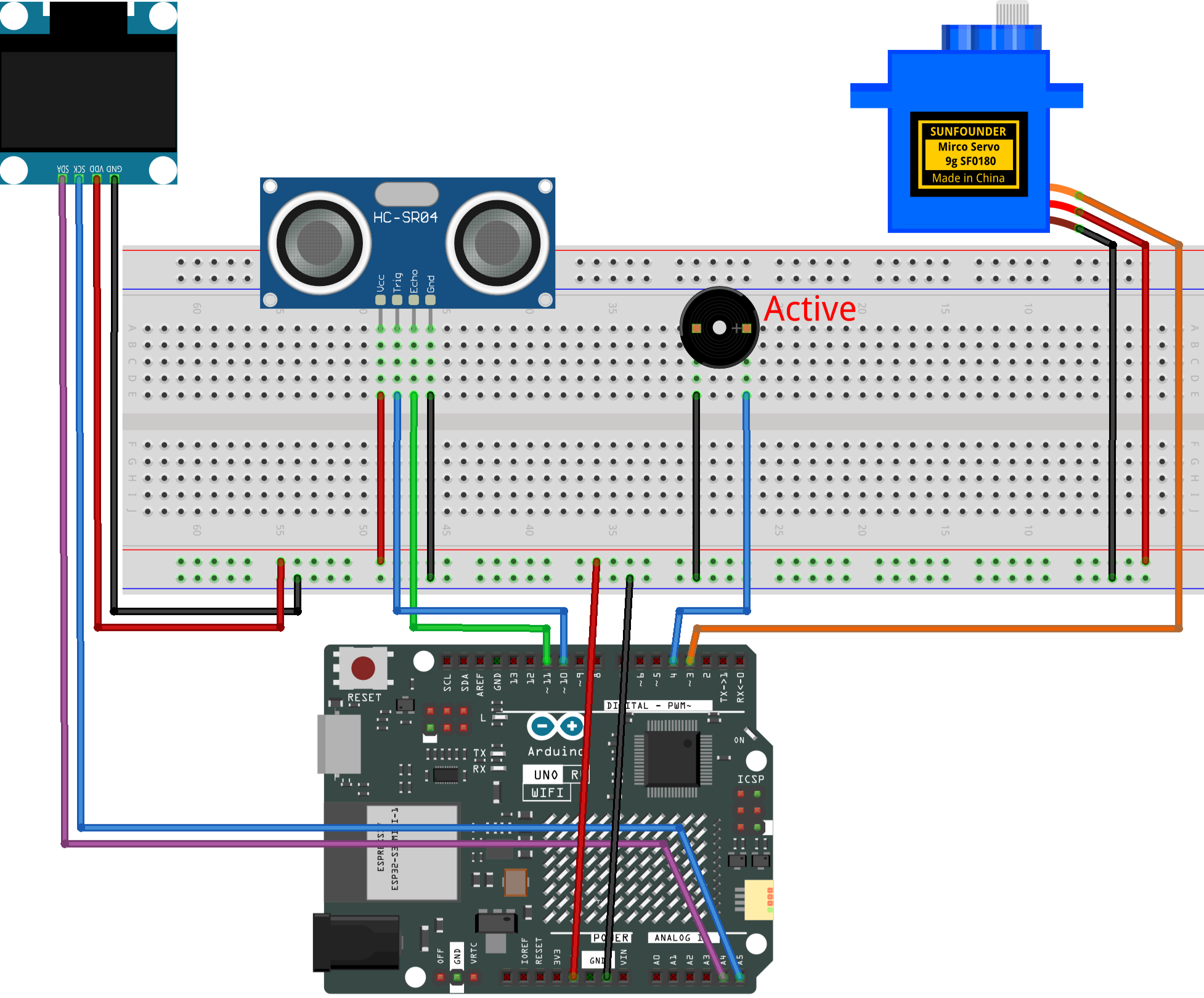
Common Connections:
Digital Servo Motor
Connect to breadboard’s positive power bus.
Connect to breadboard’s negative power bus.
Connect to 3 on the Arduino.
Active Buzzer
+: Connect to 4 on the Arduino.
-: Connect to breadboard’s negative power bus.
Ultrasonic Sensor Module Front
Trig: Connect to 10 on the Arduino.
Echo: Connect to 11 on the Arduino.
GND: Connect to breadboard’s negative power bus.
VCC: Connect to breadboard’s red power bus.
OLED Display Module
SDA: Connect to A4 on the Arduino.
SCK: Connect to A5 on the Arduino.
GND: Connect to breadboard’s negative power bus.
VCC: Connect to breadboard’s red power bus.
Writing the Code
Note
You can copy this code into Arduino IDE.
To install the library, use the Arduino Library Manager and search for Adafruit_GFX and Adafruit SSD1306 and install it.
Don’t forget to select the board(Arduino UNO R4 Minima/WIFI) and the correct port before clicking the Upload button.
#include <Wire.h>
#include <Servo.h>
#include <Adafruit_GFX.h>
#include <Adafruit_SSD1306.h>

// OLED screen settings
#define SCREEN_WIDTH 128
#define SCREEN_HEIGHT 64
#define OLED_RESET -1
#define SCREEN_ADDRESS 0x3C

Adafruit_SSD1306 display(
  SCREEN_WIDTH,
  SCREEN_HEIGHT,
  &Wire,
  OLED_RESET
);

// Ultrasonic sensor pins
const int trigPin = 10;
const int echoPin = 11;

// Servo and active buzzer pins
const int servoPin = 3;
const int buzzerPin = 4;

// Distance settings in centimeters
const int triggerDistance = 8;
const int resetDistance = 10;

Servo gameServo;

// Prevent the game from triggering repeatedly
// while your hand is still close to the sensor.
bool hasPlayed = false;

// Variables for the servo's idle shaking motion
int shakePos = 60;
bool movingRight = true;

// Prevent unnecessary OLED refreshes in idle mode
bool idleFaceShown = false;

void setup() {
  Serial.begin(9600);

  pinMode(trigPin, OUTPUT);
  pinMode(echoPin, INPUT);
  pinMode(buzzerPin, OUTPUT);

  gameServo.attach(servoPin);
  gameServo.write(90);

  // Use noise from an analog pin to make random results less predictable.
  randomSeed(analogRead(A0));

  // Start the OLED display.
  if (!display.begin(SSD1306_SWITCHCAPVCC, SCREEN_ADDRESS)) {
    Serial.println("OLED not found. Check the wiring and I2C address.");
    while (true);
  }

  drawIdleFace();
}

void loop() {
  float distance = readDistance();

  Serial.print("Distance: ");
  Serial.print(distance);
  Serial.println(" cm");

  // Start a new round when your hand is closer than triggerDistance.
  if (distance > 0 && distance < triggerDistance && !hasPlayed) {
    playGame();

    hasPlayed = true;
    idleFaceShown = false;
  }

  // Reset the game when your hand moves away.
  // The small gap between triggerDistance and resetDistance helps reduce false triggers.
  if (distance >= resetDistance || distance == -1) {
    hasPlayed = false;
  }

  // While waiting, move the servo back and forth and show the idle face.
  if (!hasPlayed) {
    shakeAnimation();

    if (!idleFaceShown) {
      drawIdleFace();
      idleFaceShown = true;
    }
  }

  delay(30);
}

float readDistance() {
  // Send a short pulse to trigger the ultrasonic sensor.
  digitalWrite(trigPin, LOW);
  delayMicroseconds(2);

  digitalWrite(trigPin, HIGH);
  delayMicroseconds(10);

  digitalWrite(trigPin, LOW);

  // Measure how long it takes for the echo signal to return.
  // The timeout prevents the program from waiting too long.
  long duration = pulseIn(echoPin, HIGH, 30000);

  // If no echo is received, return -1 as an invalid reading.
  if (duration == 0) {
    return -1;
  }

  // Convert travel time to distance in centimeters.
  return duration / 58.0;
}

void shakeAnimation() {
  // Move the servo from 60 degrees to 120 degrees, then back again.
  if (movingRight) {
    shakePos += 3;

    if (shakePos >= 120) {
      movingRight = false;
    }
  } else {
    shakePos -= 3;

    if (shakePos <= 60) {
      movingRight = true;
    }
  }

  gameServo.write(shakePos);
}

void playGame() {
  // Randomly choose Rock, Paper, or Scissors.
  int gameResult = random(0, 3);

  // Randomly choose a result face.
  // 1 = Happy, 2 = Angry, 3 = Surprised
  // The idle face is only used while waiting.
  int faceResult = random(1, 4);

  if (gameResult == 0) {
    gameServo.write(0);
    Serial.println("ROCK");
  } else if (gameResult == 1) {
    gameServo.write(90);
    Serial.println("PAPER");
  } else {
    gameServo.write(180);
    Serial.println("SCISSORS");
  }

  if (faceResult == 1) {
    drawHappyFace();
    Serial.println("Face: Happy");
  } else if (faceResult == 2) {
    drawAngryFace();
    Serial.println("Face: Angry");
  } else {
    drawSurprisedFace();
    Serial.println("Face: Surprised");
  }

  playResultSound();

  // Keep the result on the screen briefly before returning to idle mode.
  delay(500);
}

void playResultSound() {
  // This code is for an active buzzer.
  // If you are using a passive buzzer, use tone() instead.
  digitalWrite(buzzerPin, HIGH);
  delay(120);

  digitalWrite(buzzerPin, LOW);
  delay(80);

  digitalWrite(buzzerPin, HIGH);
  delay(120);

  digitalWrite(buzzerPin, LOW);
}

void drawIdleFace() {
  display.clearDisplay();

  // Calm eyes
  display.fillRoundRect(20, 18, 28, 14, 6, SSD1306_WHITE);
  display.fillRoundRect(80, 18, 28, 14, 6, SSD1306_WHITE);

  // Small smile
  display.drawPixel(50, 48, SSD1306_WHITE);
  display.drawPixel(51, 49, SSD1306_WHITE);
  display.fillRoundRect(52, 50, 24, 4, 2, SSD1306_WHITE);
  display.drawPixel(77, 49, SSD1306_WHITE);
  display.drawPixel(78, 48, SSD1306_WHITE);

  display.display();
}

void drawHappyFace() {
  display.clearDisplay();

  // Smiling eyes
  display.fillRoundRect(18, 18, 32, 8, 4, SSD1306_WHITE);
  display.fillRoundRect(78, 18, 32, 8, 4, SSD1306_WHITE);

  // Big smile
  display.fillRoundRect(40, 40, 48, 20, 10, SSD1306_WHITE);
  display.fillRoundRect(45, 40, 38, 10, 5, SSD1306_BLACK);

  display.display();
}

void drawAngryFace() {
  display.clearDisplay();

  // Slanted eyebrows
  display.fillTriangle(14, 14, 50, 14, 50, 24, SSD1306_WHITE);
  display.fillTriangle(78, 14, 114, 14, 78, 24, SSD1306_WHITE);

  // Narrow eyes
  display.fillRoundRect(18, 24, 30, 12, 4, SSD1306_WHITE);
  display.fillRoundRect(80, 24, 30, 12, 4, SSD1306_WHITE);

  // Flat mouth
  display.fillRoundRect(44, 48, 40, 8, 3, SSD1306_WHITE);

  display.display();
}

void drawSurprisedFace() {
  display.clearDisplay();

  // Wide eyes with small pupils
  display.fillRoundRect(18, 10, 32, 26, 8, SSD1306_WHITE);
  display.fillCircle(34, 23, 3, SSD1306_BLACK);

  display.fillRoundRect(78, 10, 32, 26, 8, SSD1306_WHITE);
  display.fillCircle(94, 23, 3, SSD1306_BLACK);

  // Open mouth
  display.fillRoundRect(56, 38, 16, 22, 8, SSD1306_WHITE);
  display.fillRoundRect(60, 42, 8, 14, 4, SSD1306_BLACK);

  display.display();
}