Dino Run 2.0
Note
🌟 Welcome to the SunFounder Facebook Community! Whether you’re into Raspberry Pi, Arduino, or ESP32, you’ll find inspiration, help ideas here.
✅ Be the first to get free learning resources.
✅ Stay updated on new products & exclusive giveaways.
✅ Share your creations and get real feedback.
Kit purchase
Looking for parts? Check out our all-in-one kits below — packed with components, beginner-friendly guides, and tons of fun.

Name |
Includes Arduino board |
PURCHASE LINK |
|---|---|---|
Ultimate Sensor Kit |
Arduino Uno R4 Minima |
|
Elite Explorer Kit |
Arduino Uno R4 WiFi |
|
3 in 1 Ultimate Starter Kit |
Arduino Uno R4 Minima |
|
Universal Maker Sensor Kit |
× |
Course Introduction
In this project, you’ll learn how to use a light sensor and a servo motor with the Arduino R4 UNO to create a dino run game version 2.0.
When the ambient light suddenly drops—such as when a shadow passes—the servo will quickly activate to simulate a mechanical response, like pressing a button.
This project demonstrates basic sensor input, signal filtering, and actuator control.
Note
If this is your first time working with an Arduino project, we recommend downloading and reviewing the basic materials first.
Required Components
In this project, we need the following components:
SN |
COMPONENT INTRODUCTION |
QUANTITY |
PURCHASE LINK |
|---|---|---|---|
1 |
Arduino UNO R4 Minima |
1 |
|
2 |
USB Type-C cable |
1 |
|
3 |
Breadboard |
1 |
|
4 |
Wires |
Several |
|
5 |
Digital Servo Motor |
1 |
|
6 |
Photoresistor |
1 |
Wiring
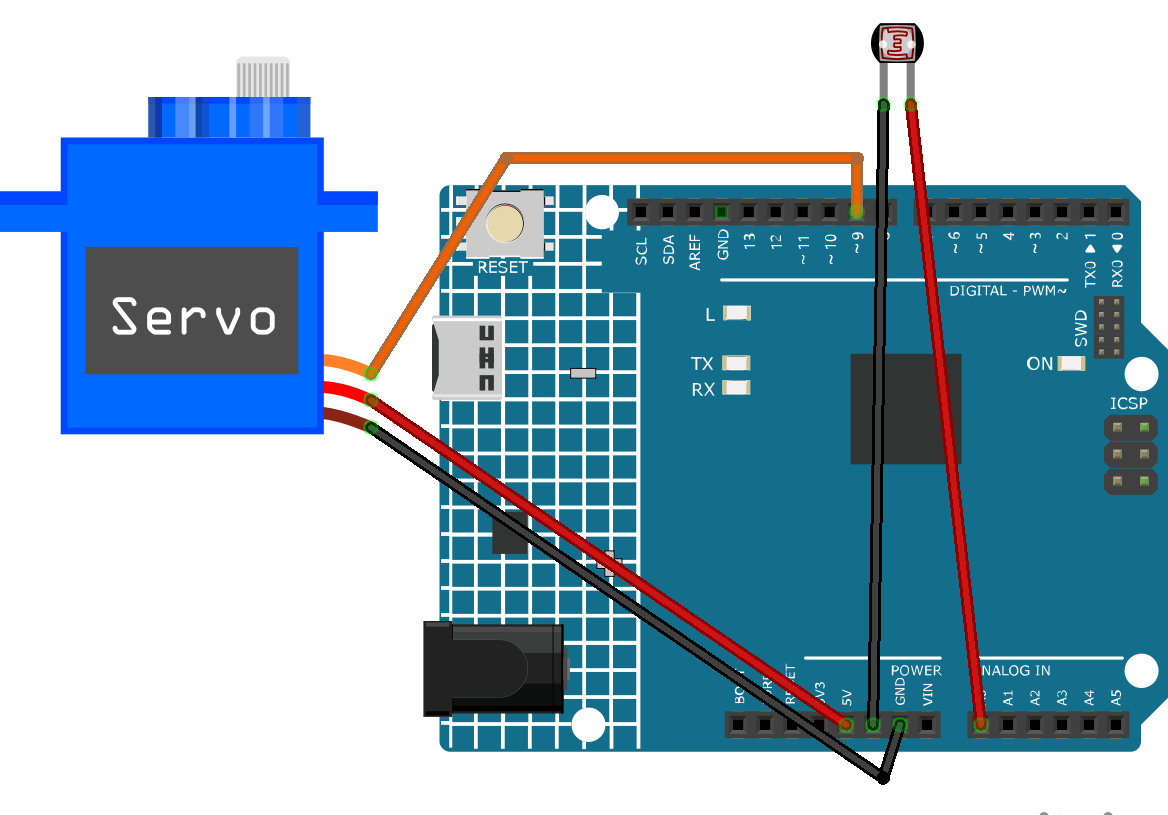
Common Connections:
Digital Servo Motor
Connect to breadboard’s positive power bus.
Connect to breadboard’s negative power bus.
Connect to 9 on the Arduino.
Photoresistor Module
VCC: Connect to A0 on the Arduino.
GND: Connect to breadboard’s negative power bus.
Writing the Code
Note
You can copy this code into Arduino IDE.
Don’t forget to select the board(Arduino UNO R4 Minima) and the correct port before clicking the Upload button.
#include <Servo.h>

// Pin definitions
const int lightSensorPin = A0;
const int servoPin = 9;

// Detection parameters
const int lightDropThreshold = 400;  // Increase threshold: trigger only if drop exceeds 400
unsigned int baselineLight = 0;      // Baseline light level at startup

// Trigger cooldown
const unsigned long detectionCooldown = 1000;
unsigned long lastDetectionTime = 0;

Servo myServo;

void setup() {
  myServo.attach(servoPin);
  myServo.write(0);
  pinMode(lightSensorPin, INPUT);
  Serial.begin(9600);

  // Initialize baseline light value: average over multiple readings
  delay(1000);  // Wait for stable startup
  baselineLight = getAverageLight(10);  // Average of 10 readings
  Serial.print("Baseline light value: ");
  Serial.println(baselineLight);
}

void loop() {
  int currentLight = getAverageLight(5);  // Current light average (more stable)
  unsigned long currentTime = millis();

  Serial.print("Current light: ");
  Serial.println(currentLight);

  // Check if there's a significant drop in light
  if ((baselineLight - currentLight) > lightDropThreshold && currentTime - lastDetectionTime > detectionCooldown) {
    myServo.write(90);   // Rotate
    delay(150);          // Hold the position
    myServo.write(0);    // Return to original position
    lastDetectionTime = currentTime;
  }

  delay(10);
}

// Get average light value to avoid accidental triggers
int getAverageLight(int samples) {
  long total = 0;
  for (int i = 0; i < samples; i++) {
    total += analogRead(lightSensorPin);
    delay(1);  // Small delay between readings
  }
  return total / samples;
}