Smart Stop 1.0
Note
🌟 Welcome to the SunFounder Facebook Community! Whether you’re into Raspberry Pi, Arduino, or ESP32, you’ll find inspiration, help ideas here.
✅ Be the first to get free learning resources.
✅ Stay updated on new products & exclusive giveaways.
✅ Share your creations and get real feedback.
Kit purchase
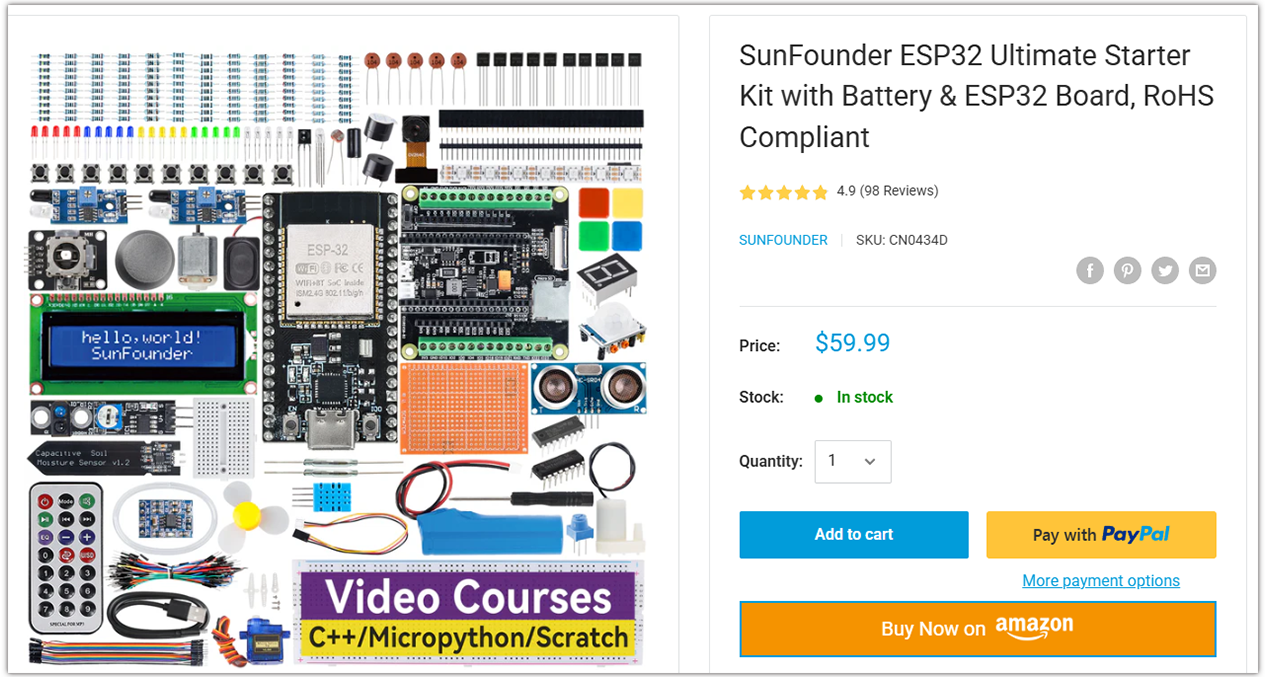
Looking for parts? Check out our all-in-one kits below — packed with components, beginner-friendly guides, and tons of fun.
Name |
Includes ESP32 board |
PURCHASE LINK |
|---|---|---|
ESP32 Ultimate Starter Kit |
ESP32 WROOM 32E + |
|
Universal Maker Sensor Kit |
Course Introduction
In this lesson, you’ll learn how to use an L9110 Motor Driver Module, an Ultrasonic Sensor Module, and a TT motor with the ESP32 to create a Smart Stop 1.0 system.
As the obstacle gets closer to the Ultrasonic Sensor Module, the TT motor gradually slows down until it comes to a stop.
Note
If this is your first time working with an ESP32 project, we recommend downloading and reviewing the basic materials first.
Required Components
In this project, we need the following components:
SN |
COMPONENT INTRODUCTION |
QUANTITY |
PURCHASE LINK |
|---|---|---|---|
1 |
ESP-WROOM-32 ESP32 ESP-32S Development Board |
1 |
|
2 |
USB Cable |
1 |
|
3 |
Breadboard |
1 |
|
4 |
Wires |
Several |
|
5 |
L9110 Motor Driver Module |
1 |
|
6 |
Ultrasonic Sensor Module |
1 |
|
7 |
TT Motor |
1 |
Wiring
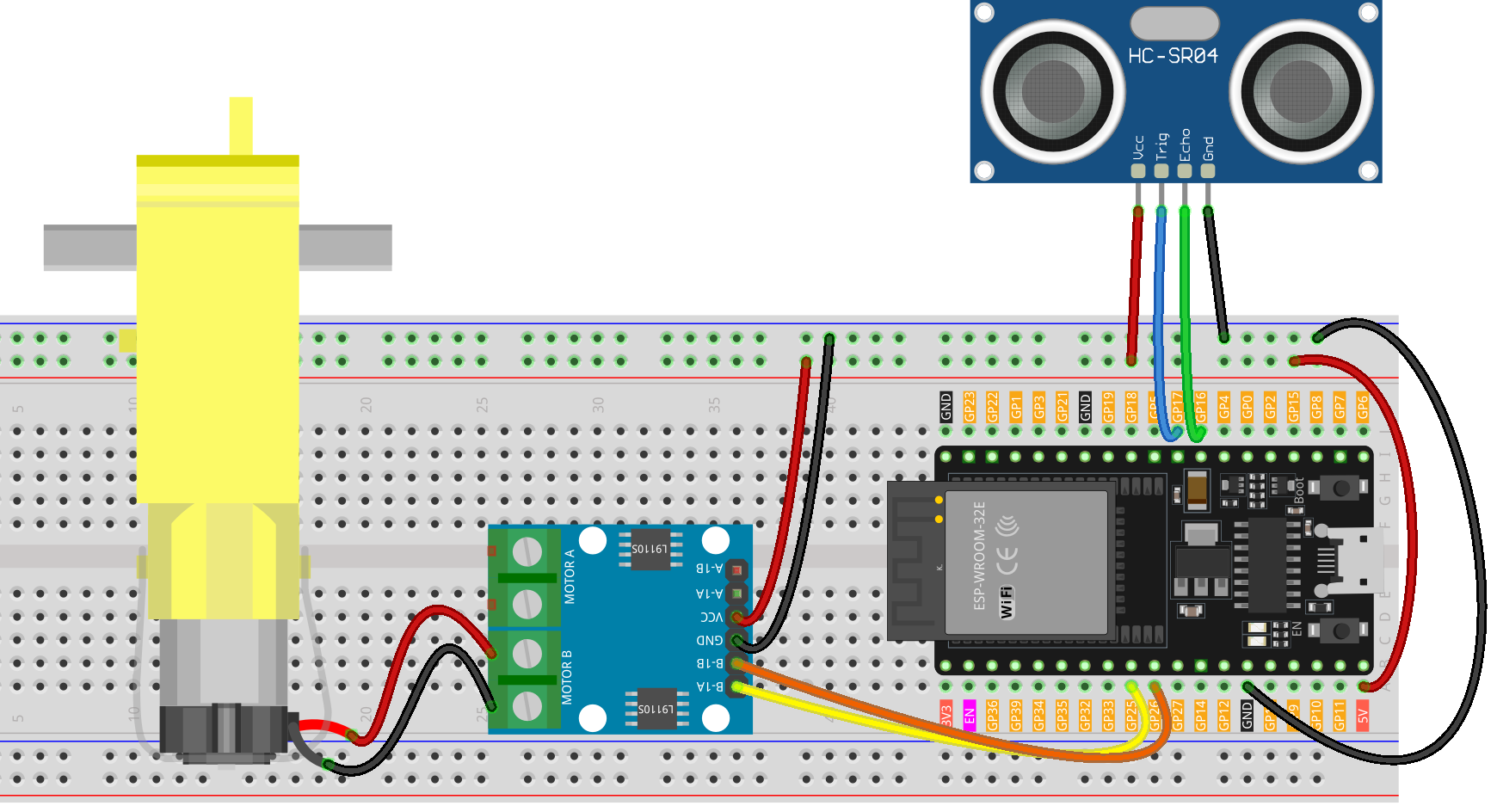
Common Connections:
Ultrasonic Sensor Module
Trig: Connect to GPIO17 on the ESP32.
Echo: Connect to GPIO16 on the ESP32.
GND: Connect to breadboard’s negative power bus.
VCC: Connect to breadboard’s 5V red power bus.
TT Motor
Connect to MOTOR B on the L9110 Motor Driver Module.
L9110 Motor Driver Module
GND: Connect to breadboard’s negative power bus.
VCC: Connect to breadboard’s 5V red power bus.
B-1B: Connect to GPIO26 on the ESP32.
B-1A: Connect to GPIO25 on the ESP32.
Writing the Code
Note
You can copy this code into Arduino IDE.
Don’t forget to select the board(ESP32 Dev module) and the correct port before clicking the Upload button.
#include <Arduino.h>

// ---- Pin mapping for ESP32 ----
// Ultrasonic sensor (HC-SR04)
const int trigPin   = 17;   // TRIG (3.3V OK)
const int echoPin   = 16;   // ECHO -> must be divided to ~3.3V on ESP32

// L9110 motor driver (B channel)
const int motorB_1A = 25;   // L9110 B-IA / IN1B
const int motorB_2A = 26;   // L9110 B-IB / IN2B

void setup() {
  Serial.begin(9600);                 // Serial monitor

  // Ultrasonic I/O
  pinMode(trigPin, OUTPUT);
  pinMode(echoPin, INPUT);

  // Motor outputs
  pinMode(motorB_1A, OUTPUT);
  pinMode(motorB_2A, OUTPUT);

  // Ensure motor is stopped at startup
  analogWrite(motorB_1A, 0);
  analogWrite(motorB_2A, 0);
}

void loop() {
  float distance = readSensorData();  // Read distance (cm)
  Serial.print("Distance: ");
  Serial.print(distance, 2);
  Serial.println(" cm");

  controlMotor(distance);             // Drive motor based on distance
  delay(100);                         // Small delay to reduce noise
}

// Read distance from HC-SR04 (returns centimeters)
float readSensorData() {
  // Send 10 µs trigger pulse
  digitalWrite(trigPin, LOW);
  delayMicroseconds(2);
  digitalWrite(trigPin, HIGH);
  delayMicroseconds(10);
  digitalWrite(trigPin, LOW);

  // Measure echo pulse width with timeout (30 ms)
  unsigned long duration = pulseIn(echoPin, HIGH, 30000UL);
  if (duration == 0) return 9999.0f;  // Timeout -> treat as very far

  // Convert to centimeters (duration/58 is a common shortcut)
  return duration / 58.0f;
}

// Control DC motor via L9110 (forward on B-IA, B-IB kept low)
void controlMotor(float distance) {
  if (distance < 5) {
    // Stop
    analogWrite(motorB_1A, 0);
    analogWrite(motorB_2A, 0);
  } else if (distance < 8) {
    // Slow
    analogWrite(motorB_1A, 85);
    analogWrite(motorB_2A, 0);
  } else if (distance < 11) {
    // Medium
    analogWrite(motorB_1A, 170);
    analogWrite(motorB_2A, 0);
  } else if (distance > 14) {
    // Max
    analogWrite(motorB_1A, 255);
    analogWrite(motorB_2A, 0);
  } else {
    // 11–14 cm -> stop (matches original implicit behavior)
    analogWrite(motorB_1A, 0);
    analogWrite(motorB_2A, 0);
  }
}