Gas Leak Monitor
Note
🌟 Welcome to the SunFounder Facebook Community! Whether you’re into Raspberry Pi, Arduino, or ESP32, you’ll find inspiration, help ideas here.
✅ Be the first to get free learning resources.
✅ Stay updated on new products & exclusive giveaways.
✅ Share your creations and get real feedback.
Kit purchase
Looking for parts? Check out our all-in-one kits below — packed with components, beginner-friendly guides, and tons of fun.

Name |
Includes ESP32 board |
PURCHASE LINK |
|---|---|---|
ESP32 Ultimate Starter Kit |
ESP32 WROOM 32E + |
|
Universal Maker Sensor Kit |
Course Introduction
This project simulates a basic gas leak detection system using an MQ-2 gas sensor, a red LED, and a buzzer.
The sensor continuously monitors gas concentration. If the reading exceeds a set threshold, the buzzer sounds and the LED blinks to indicate danger.
Otherwise, the system remains silent and the LED stays off.
Note
If this is your first time working with an ESP32 project, we recommend downloading and reviewing the basic materials first.
Required Components
In this project, we need the following components:
SN |
COMPONENT INTRODUCTION |
QUANTITY |
PURCHASE LINK |
|---|---|---|---|
1 |
ESP-WROOM-32 ESP32 ESP-32S Development Board |
1 |
|
2 |
USB Type-C cable |
1 |
|
3 |
Breadboard |
1 |
|
4 |
Wires |
Several |
|
5 |
Buzzer Modudle |
1 |
|
6 |
LED |
1 |
|
7 |
MQ-2 Gas Sensor Module |
1 |
|
8 |
220Ω resistor |
1 |
Wiring
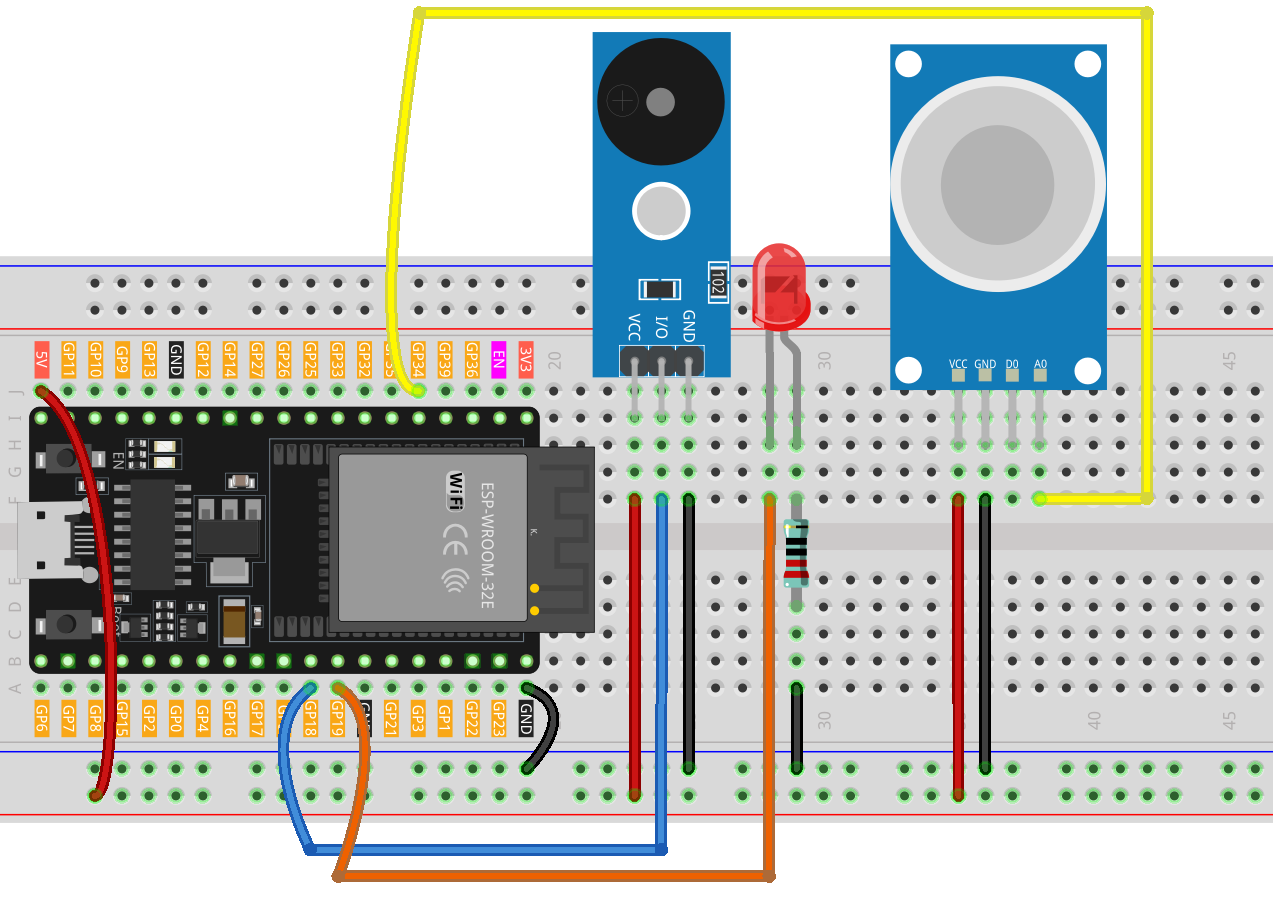
Common Connections:
MQ-2 Gas Sensor Module
A0: Connect to GPIO34 on the ESP32.
GND: Connect to breadboard’s negative power bus.
VCC: Connect to breadboard’s red power bus.
Buzzer Modudle
I/O: Connect to GPIO18 on the ESP32.
GND: Connect to breadboard’s negative power bus.
VCC: Connect to breadboard’s red power bus.
LED
Connect the LED anode to GPIO19 on the ESP32, and the cathode to a 220Ω resistor , then to the negative power bus on the breadboard.
Writing the Code
Note
You can copy this code into Arduino IDE.
Don’t forget to select the board(ESP32 Dev Module) and the correct port before clicking the Upload button.
/*
  Board: ESP32 Dev Module (or similar)
  Components: MQ-2 gas sensor (analog), red LED, buzzer
  Purpose: Simulate gas leak detection.

  Logic:
  - If gas concentration > threshold: buzzer sounds, red LED blinks.
  - Otherwise: buzzer is off, red LED is off.
*/

const int sensorPin = 34;      // MQ-2 analog output (ESP32 ADC pin)
const int buzzerPin = 18;      // Buzzer pin (GPIO 18)
const int redLEDPin = 19;      // Red LED pin (GPIO 19)

int sensorValue = 0;           // Variable to store sensor value

// On ESP32, analogRead() returns 0–4095 (12-bit).
// Original threshold 90 (on 0–1023) ≈ 360 on 0–4095.
const int threshold = 720;     // Gas detection threshold (tune as needed)

void setup() {
  Serial.begin(115200);        // Initialize serial monitor (higher baud for ESP32)

  pinMode(buzzerPin, OUTPUT);  // Set buzzer pin as output
  pinMode(redLEDPin, OUTPUT);  // Set red LED pin as output

  digitalWrite(buzzerPin, LOW);
  digitalWrite(redLEDPin, LOW);
}

void loop() {
  // Read sensor value (0–4095 on ESP32 ADC)
  sensorValue = analogRead(sensorPin);

  Serial.print("Analog output: ");
  Serial.println(sensorValue);

  if (sensorValue > threshold) {
    // Gas above threshold: buzzer ON, LED blinking
    tone(buzzerPin, 500);          // 500 Hz tone on buzzer
    digitalWrite(redLEDPin, HIGH); // LED ON
    delay(250);
    digitalWrite(redLEDPin, LOW);  // LED OFF
    delay(250);                    // Total blink period = 500 ms
  } else {
    // Gas below threshold: buzzer OFF, LED OFF
    noTone(buzzerPin);             // Stop buzzer
    digitalWrite(redLEDPin, LOW);  // LED OFF
    delay(50);
  }
}