Color Memory
Note
🌟 Welcome to the SunFounder Facebook Community! Whether you’re into Raspberry Pi, Arduino, or ESP32, you’ll find inspiration, help ideas here.
✅ Be the first to get free learning resources.
✅ Stay updated on new products & exclusive giveaways.
✅ Share your creations and get real feedback.
Kit purchase
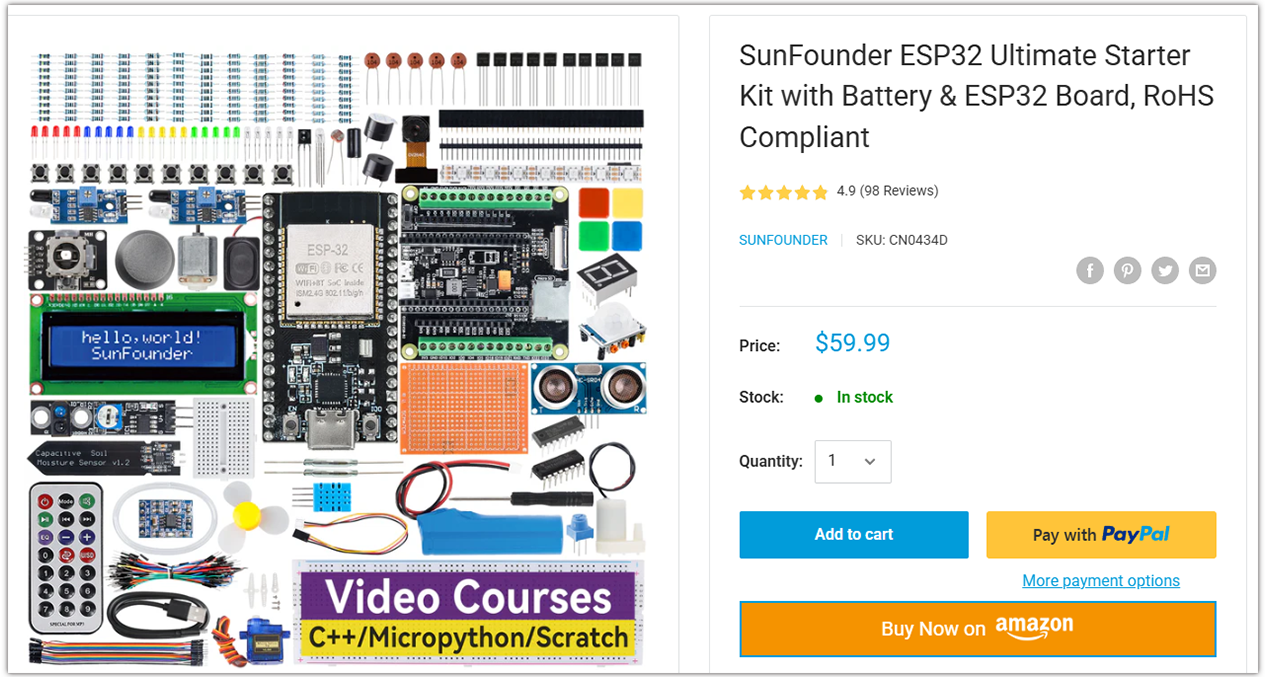
Looking for parts? Check out our all-in-one kits below — packed with components, beginner-friendly guides, and tons of fun.
Name |
Includes ESP32 board |
PURCHASE LINK |
|---|---|---|
ESP32 Ultimate Starter Kit |
ESP32 WROOM 32E + |
|
Universal Maker Sensor Kit |
Course Introduction
In this lesson, you’ll use four LCDs, four buttons, and a passive buzzer with the ESP32 to create a color memory game.
At the start of the game, an LED lights up at random. The player must press the corresponding button to proceed. A wrong input ends the game.
Note
If this is your first time working with an ESP32 project, we recommend downloading and reviewing the basic materials first.
Required Components
In this project, we need the following components:
SN |
COMPONENT INTRODUCTION |
QUANTITY |
PURCHASE LINK |
|---|---|---|---|
1 |
ESP-WROOM-32 ESP32 ESP-32S Development Board |
1 |
|
2 |
USB Type-C cable |
1 |
|
3 |
Breadboard |
1 |
|
4 |
Wires |
Several |
|
5 |
Passive Buzzer |
1 |
|
6 |
Button |
4 |
|
7 |
LED |
4 |
|
8 |
220Ω resistor |
4 |
Wiring

Common Connections:
LEDS
Blue: Connect the LED anode to GPIO19 on the ESP32, and the cathode to a 1kΩ resistor, then to the negative power bus on the breadboard.
Green: Connect the LED anode to GPIO18 on the ESP32, and the cathode to a 1kΩ resistor, then to the negative power bus on the breadboard.
Yellow: Connect the LED anode to GPIO17**on the ESP32 , and the **cathode to a 1kΩ resistor, then to the negative power bus on the breadboard.
Red: Connect the LED anode to GPIO16 on the ESP32, and the cathode to a 1kΩ resistor, then to the negative power bus on the breadboard.
Passive Buzzer
+: Connect to GPIO27 on the ESP32.
-: Connect to breadboard’s negative power bus.
Buttons
Blue Button: Connect to the Blue LED’s cathode on the breadboard, and the other end to GPIO26 on the ESP32 board.
Green Butto: Connect to the Green LED’s cathode on the breadboard, and the other end to GPIO25 on the ESP32 board.
Yellow Butto: Connect to the Yellow LED’s cathode on the breadboard, and the other end to GPIO33 on the ESP32 board.
Red Butto: Connect to the Red LED’s cathode on the breadboard, and the other end to GPIO32 on the ESP32 board.
Writing the Code
Note
You can copy this code into Arduino IDE. * To install the library, use the Arduino Library Manager and search for esp_system and install it.
Don’t forget to select the board(ESP32 Dev module) and the correct port before clicking the Upload button.
#include <esp_system.h>  // for esp_random()

// ===== LED and button pin definitions (ESP32 safe GPIOs) =====
// Avoid flash pins (6–11) and strapping pins (0/2/12/15) for reliability.
const int redLED    = 16;
const int yellowLED = 17;
const int greenLED  = 18;
const int blueLED   = 19;

const int redButton    = 32;  // has internal pull-up
const int yellowButton = 33;  // has internal pull-up
const int greenButton  = 25;  // has internal pull-up
const int blueButton   = 26;  // has internal pull-up

const int buzzer = 27;        // works with tone() on ESP32

// ===== Game state =====
int sequence[100];     // Generated color sequence
int playerInput[100];  // Player-entered sequence
int level = 0;         // Current level (1..)
bool gameOver = false; // Game over flag

void startGame();
void playSequence();
bool getPlayerInput();
void endGame();
void lightUpLED(int color);

void setup() {
  // LED outputs
  pinMode(redLED, OUTPUT);
  pinMode(yellowLED, OUTPUT);
  pinMode(greenLED, OUTPUT);
  pinMode(blueLED, OUTPUT);

  // Buttons as inputs with internal pull-ups (wire the other side to GND)
  pinMode(redButton,    INPUT_PULLUP);
  pinMode(yellowButton, INPUT_PULLUP);
  pinMode(greenButton,  INPUT_PULLUP);
  pinMode(blueButton,   INPUT_PULLUP);

  // Buzzer output
  pinMode(buzzer, OUTPUT);

  Serial.begin(115200);

  // Seed RNG from ESP32 hardware random generator
  randomSeed((uint32_t)esp_random());

  // Start the game
  startGame();
}

void loop() {
  if (!gameOver) {
    // Play current sequence and then check player's input
    playSequence();

    if (!getPlayerInput()) {
      endGame();
    } else {
      delay(500);  // brief pause before next level
    }
  } else {
    // Restart after a short delay
    delay(1500);
    startGame();
  }
}

void startGame() {
  level = 1;
  gameOver = false;

  // Power-on cue: all LEDs on + short beep
  digitalWrite(redLED, HIGH);
  digitalWrite(yellowLED, HIGH);
  digitalWrite(greenLED, HIGH);
  digitalWrite(blueLED, HIGH);
  tone(buzzer, 1000, 500);
  delay(500);

  // All off
  digitalWrite(redLED, LOW);
  digitalWrite(yellowLED, LOW);
  digitalWrite(greenLED, LOW);
  digitalWrite(blueLED, LOW);

  delay(300);
}

void playSequence() {
  // Append one random color (1..4) to the sequence for this level
  sequence[level - 1] = random(1, 5);

  // Play the sequence up to current level
  for (int i = 0; i < level; i++) {
    lightUpLED(sequence[i]);
    delay(300);
  }
}

bool getPlayerInput() {
  for (int i = 0; i < level; i++) {
    bool inputReceived = false;

    // Wait until any button is pressed (active LOW)
    while (!inputReceived) {
      if (digitalRead(redButton) == LOW) {
        playerInput[i] = 1;
        lightUpLED(1);
        inputReceived = true;
      } else if (digitalRead(yellowButton) == LOW) {
        playerInput[i] = 2;
        lightUpLED(2);
        inputReceived = true;
      } else if (digitalRead(greenButton) == LOW) {
        playerInput[i] = 3;
        lightUpLED(3);
        inputReceived = true;
      } else if (digitalRead(blueButton) == LOW) {
        playerInput[i] = 4;
        lightUpLED(4);
        inputReceived = true;
      }
      // simple debounce
      delay(5);
    }

    // Verify input against the sequence
    if (playerInput[i] != sequence[i]) {
      return false;  // mismatch -> fail
    }

    // Wait for button release before next input
    while (digitalRead(redButton)   == LOW ||
          digitalRead(yellowButton)== LOW ||
          digitalRead(greenButton) == LOW ||
          digitalRead(blueButton)  == LOW) {
      delay(5);
    }

    delay(200);
  }

  // Advance to next level after a full correct round
  level++;
  return true;
}

void endGame() {
  gameOver = true;

  // Flash all LEDs and beep to indicate game over
  for (int i = 0; i < 5; i++) {
    digitalWrite(redLED, HIGH);
    digitalWrite(yellowLED, HIGH);
    digitalWrite(greenLED, HIGH);
    digitalWrite(blueLED, HIGH);
    tone(buzzer, 1000, 300);
    delay(200);

    digitalWrite(redLED, LOW);
    digitalWrite(yellowLED, LOW);
    digitalWrite(greenLED, LOW);
    digitalWrite(blueLED, LOW);
    delay(200);
  }
}

void lightUpLED(int color) {
  // Light a specific LED and play a tone depending on color
  switch (color) {
    case 1: // Red
      digitalWrite(redLED, HIGH);
      tone(buzzer, 500, 300);
      break;
    case 2: // Yellow
      digitalWrite(yellowLED, HIGH);
      tone(buzzer, 600, 300);
      break;
    case 3: // Green
      digitalWrite(greenLED, HIGH);
      tone(buzzer, 700, 300);
      break;
    case 4: // Blue
      digitalWrite(blueLED, HIGH);
      tone(buzzer, 800, 300);
      break;
  }

  delay(300);

  // Turn all LEDs off
  digitalWrite(redLED, LOW);
  digitalWrite(yellowLED, LOW);
  digitalWrite(greenLED, LOW);
  digitalWrite(blueLED, LOW);
}