Parking Lot
Note
🌟 Welcome to the SunFounder Facebook Community! Whether you’re into Raspberry Pi, Arduino, or ESP32, you’ll find inspiration, help ideas here.
✅ Be the first to get free learning resources.
✅ Stay updated on new products & exclusive giveaways.
✅ Share your creations and get real feedback.
Kit purchase
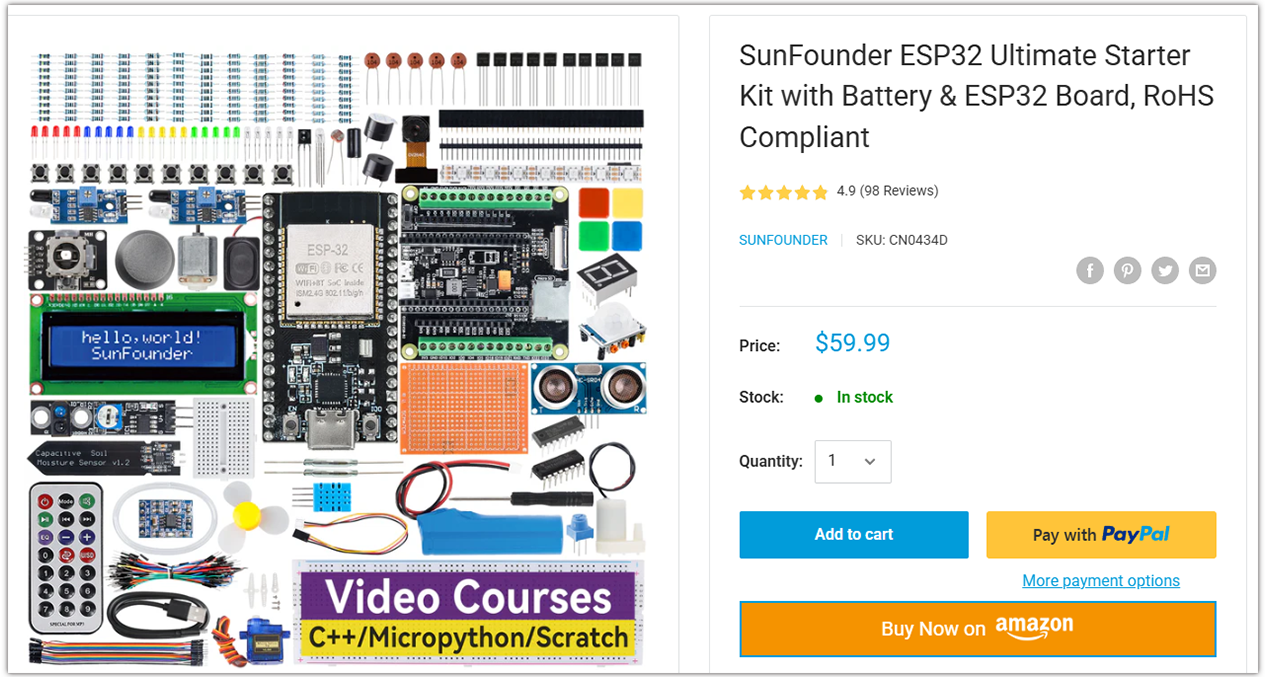
Looking for parts? Check out our all-in-one kits below — packed with components, beginner-friendly guides, and tons of fun.
Name |
Includes ESP32 board |
PURCHASE LINK |
|---|---|---|
ESP32 Ultimate Starter Kit |
ESP32 WROOM 32E + |
|
Universal Maker Sensor Kit |
Course Introduction
In this project, you will use ESP32 board, a servo motor, IR sensors, and a traffic light module to build an intelligent parking lot barrier system.
The system detects vehicles with IR sensors, automatically controls the barrier gate, updates the car count on the LCD, and manages the traffic light for safe entry and exit.
Note
If this is your first time working with an ESP32 project, we recommend downloading and reviewing the basic materials first.
Required Components
In this project, we need the following components:
SN |
COMPONENT INTRODUCTION |
QUANTITY |
PURCHASE LINK |
|---|---|---|---|
1 |
ESP-WROOM-32 ESP32 ESP-32S Development Board |
1 |
|
2 |
USB Type-C cable |
1 |
|
3 |
Breadboard |
1 |
|
4 |
Wires |
Several |
|
5 |
IR Obstacle Avoidance Sensor Module |
2 |
|
6 |
Digital Servo Motor |
1 |
|
7 |
I2C LCD 1602 |
1 |
|
8 |
Traffic Light LED |
1 |
Wiring
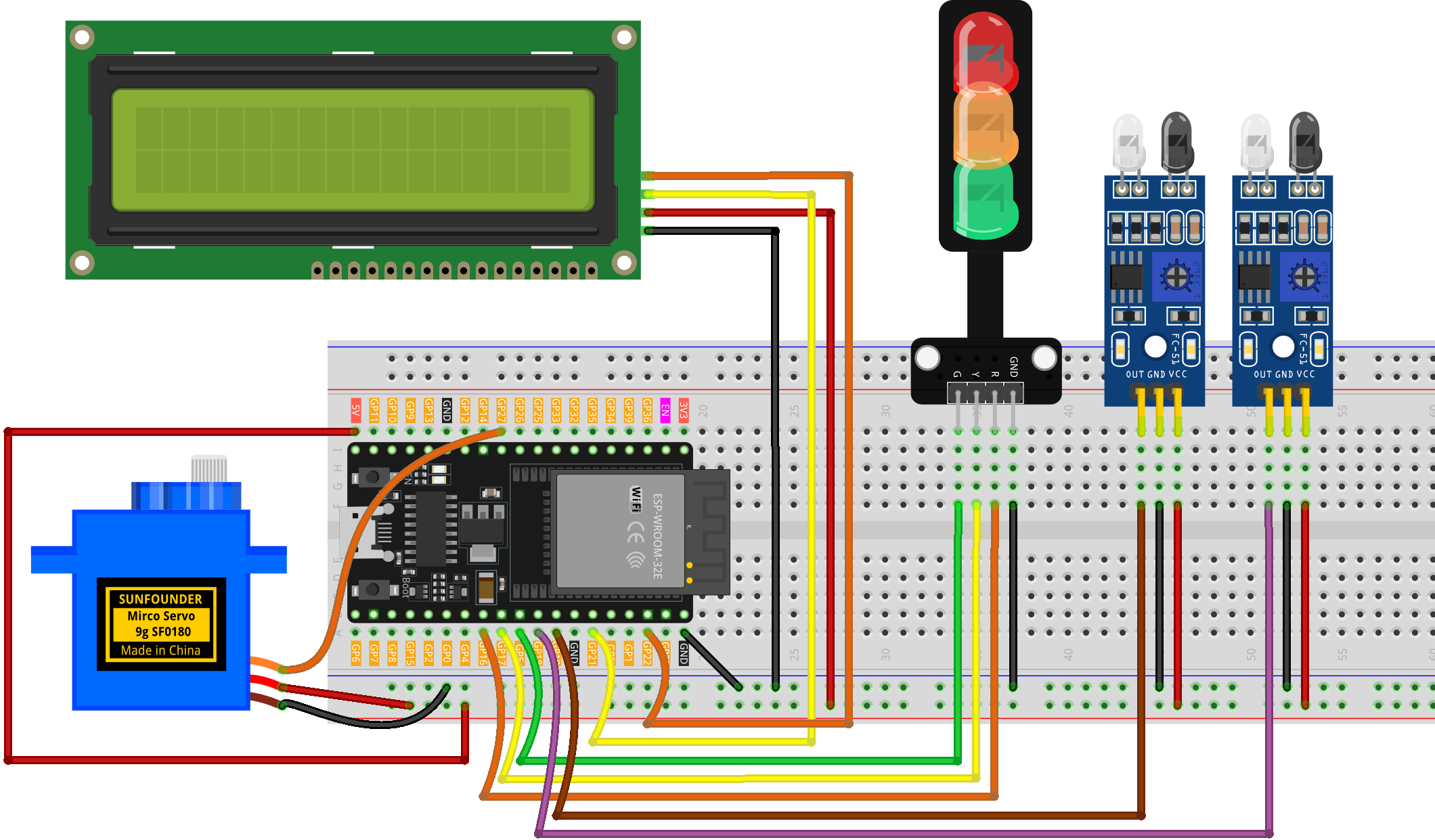
Common Connections:
Traffic light LED
R: Connect to GPIO16 on the ESP32.
Y: Connect to GPIO17 on the ESP32.
G: Connect to GPIO5 on the ESP32.
GND: Connect to breadboard’s negative power bus.
Digital Servo Motor
Connect to breadboard’s positive power bus.
Connect to breadboard’s negative power bus.
Connect to GPIO27 on the ESP32.
IR Obstacle Avoidance Sensor Module Entrance
OUT: Connect to GPIO18 on the ESP32.
GND: Connect to breadboard’s negative power bus.
VCC: Connect to breadboard’s red power bus.
IR Obstacle Avoidance Sensor Module Exit
OUT: Connect to GPIO19 on the ESP32.
GND: Connect to breadboard’s negative power bus.
VCC: Connect to breadboard’s red power bus.
I2C LCD 1602
SDA: Connect to GPIO21 on the ESP32.
SCL: Connect to GPIO22 on the ESP32.
GND: Connect to breadboard’s negative power bus.
VCC: Connect to breadboard’s red power bus.
Writing the Code
Note
You can copy this code into Arduino IDE.
To install the library, use the Arduino Library Manager and search for LiquidCrystal I2C and ESP32Servo and install it.
Don’t forget to select the board(ESP32 Dev module) and the correct port before clicking the Upload button.
// ESP32 version of Parking Lot Gate
#include <Wire.h>
#include <LiquidCrystal_I2C.h>
#include <ESP32Servo.h>

// === Pin mapping (ESP32 safe GPIOs) ===
const int SERVO_PIN   = 27;

const int IR1_PIN     = 18;  // Entrance IR (active LOW)
const int IR2_PIN     = 19;  // Exit IR (active LOW)

const int RED_PIN     = 16;
const int YELLOW_PIN  = 17;
const int GREEN_PIN   = 5;

// LCD (I2C 0x27, 16x2)
LiquidCrystal_I2C lcd(0x27, 16, 2);

// Servo
Servo gateServo;

// Status variable
int carCount = 2;

enum State {
  IDLE,
  ENTER_WAIT_YELLOW,
  ENTER_WAIT_GREEN,
  ENTER_WAIT_EXIT,
  EXIT_WAIT_YELLOW,
  EXIT_WAIT_GREEN,
  EXIT_WAIT_EXIT
};

State state = IDLE;

// Timing
unsigned long stateStartTime     = 0;
const unsigned long YELLOW_BLINK_TIME = 2000;
const unsigned long GREEN_TIME        = 1000;
bool yellowBlinkState = false;
unsigned long lastBlinkTime      = 0;
const unsigned long BLINK_INTERVAL   = 300;

void setTrafficLight(char color);
void updateLCD();

void setup() {
  // I2C on ESP32 (SDA=21, SCL=22)
  Wire.begin(21, 22);

  // LCD
  lcd.init();
  lcd.backlight();
  lcd.setCursor(0, 0);
  lcd.print("Parking Lot");
  lcd.setCursor(0, 1);
  lcd.print("Car Count: ");
  lcd.print(carCount);

  // Servo (50 Hz typical). Optionally specify pulse range for your servo:
  // gateServo.attach(SERVO_PIN, 500, 2500);
  gateServo.attach(SERVO_PIN);
  gateServo.write(0); // barrier down

  // IR sensors: use internal pull-ups; active LOW when beam broken/object present
  pinMode(IR1_PIN, INPUT_PULLUP);
  pinMode(IR2_PIN, INPUT_PULLUP);

  // Traffic lights
  pinMode(RED_PIN, OUTPUT);
  pinMode(YELLOW_PIN, OUTPUT);
  pinMode(GREEN_PIN, OUTPUT);
  setTrafficLight('R');
}

void loop() {
  bool ir1State = (digitalRead(IR1_PIN) == LOW); // LOW = triggered
  bool ir2State = (digitalRead(IR2_PIN) == LOW); // LOW = triggered
  unsigned long now = millis();

  switch (state) {
    case IDLE:
      setTrafficLight('R');
      gateServo.write(0); // barrier down
      if (ir1State) { // entry detected
        state = ENTER_WAIT_YELLOW;
        stateStartTime = now;
        lastBlinkTime = now;
        yellowBlinkState = false;
      } else if (ir2State) { // exit detected
        state = EXIT_WAIT_YELLOW;
        stateStartTime = now;
        lastBlinkTime = now;
        yellowBlinkState = false;
      }
      break;

    case ENTER_WAIT_YELLOW:
      if (now - lastBlinkTime > BLINK_INTERVAL) {
        yellowBlinkState = !yellowBlinkState;
        digitalWrite(YELLOW_PIN, yellowBlinkState ? HIGH : LOW);
        lastBlinkTime = now;
      }
      if (now - stateStartTime > YELLOW_BLINK_TIME) {
        digitalWrite(YELLOW_PIN, LOW);
        setTrafficLight('G');
        gateServo.write(90); // raise barrier
        state = ENTER_WAIT_GREEN;
        stateStartTime = now;
      }
      break;

    case ENTER_WAIT_GREEN:
      if (now - stateStartTime > GREEN_TIME) {
        state = ENTER_WAIT_EXIT; // wait for IR2 to count entry
      }
      break;

    case ENTER_WAIT_EXIT:
      if (ir2State) {
        carCount++;
        updateLCD();
        setTrafficLight('R');
        gateServo.write(0); // barrier down
        state = IDLE;
        // wait until IR released (simple debounce)
        while (digitalRead(IR2_PIN) == LOW) { delay(10); }
      }
      break;

    case EXIT_WAIT_YELLOW:
      if (now - lastBlinkTime > BLINK_INTERVAL) {
        yellowBlinkState = !yellowBlinkState;
        digitalWrite(YELLOW_PIN, yellowBlinkState ? HIGH : LOW);
        lastBlinkTime = now;
      }
      if (now - stateStartTime > YELLOW_BLINK_TIME) {
        digitalWrite(YELLOW_PIN, LOW);
        setTrafficLight('G');
        gateServo.write(90); // raise barrier
        state = EXIT_WAIT_GREEN;
        stateStartTime = now;
      }
      break;

    case EXIT_WAIT_GREEN:
      if (now - stateStartTime > GREEN_TIME) {
        state = EXIT_WAIT_EXIT; // wait for IR1 to count exit
      }
      break;

    case EXIT_WAIT_EXIT:
      if (ir1State) {
        if (carCount > 0) carCount--;
        updateLCD();
        setTrafficLight('R');
        gateServo.write(0); // barrier down
        state = IDLE;
        while (digitalRead(IR1_PIN) == LOW) { delay(10); }
      }
      break;
  }
}

void setTrafficLight(char color) {
  switch (color) {
    case 'R':
      digitalWrite(RED_PIN, HIGH);
      digitalWrite(YELLOW_PIN, LOW);
      digitalWrite(GREEN_PIN, LOW);
      break;
    case 'Y':
      digitalWrite(RED_PIN, LOW);
      digitalWrite(YELLOW_PIN, HIGH);
      digitalWrite(GREEN_PIN, LOW);
      break;
    case 'G':
      digitalWrite(RED_PIN, LOW);
      digitalWrite(YELLOW_PIN, LOW);
      digitalWrite(GREEN_PIN, HIGH);
      break;
  }
}

void updateLCD() {
  lcd.setCursor(0, 1);
  lcd.print("Car Count:    ");
  lcd.setCursor(11, 1);
  lcd.print(carCount);
}