Note
Hello, welcome to the SunFounder Raspberry Pi & Arduino & ESP32 Enthusiasts Community on Facebook! Dive deeper into Raspberry Pi, Arduino, and ESP32 with fellow enthusiasts.
Why Join?
Expert Support: Solve post-sale issues and technical challenges with help from our community and team.
Learn & Share: Exchange tips and tutorials to enhance your skills.
Exclusive Previews: Get early access to new product announcements and sneak peeks.
Special Discounts: Enjoy exclusive discounts on our newest products.
Festive Promotions and Giveaways: Take part in giveaways and holiday promotions.
👉 Ready to explore and create with us? Click [here] and join today!
74HC595
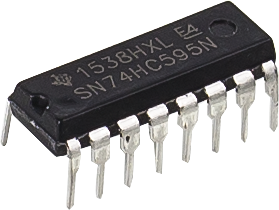
The 74HC595 is an integrated circuit featuring an 8-bit shift register and a storage register with tri-state parallel outputs. It converts serial input into parallel output, allowing you to conserve MCU I/O pins.
When MR (pin 10) is set to high level and OE (pin 13) is set to low level, data is clocked into the shift register on the rising edge of SHcp and transferred to the storage register on the rising edge of STcp.
If the two clock signals are connected, the shift register will always operate one clock pulse ahead of the storage register.
The shift register includes a serial input pin (Ds), a serial output pin (Q7’), and an asynchronous reset (active low).
The storage register outputs an 8-bit parallel bus in three states.
When OE is enabled (low level), the data stored in the storage register is output to the parallel bus (Q0 ~ Q7).

Pins of 74HC595 and their functions:
Q0-Q7: 8-bit parallel data output pins, able to control 8 LEDs or 8 pins of 7-segment display directly.
Q7’: Series output pin, connected to DS of another 74HC595 to connect multiple 74HC595s in series
MR: Reset pin, active at low level;
SHcp: Time sequence input of shift register. On the rising edge, the data in shift register moves successively one bit, i.e. data in Q1 moves to Q2, and so forth. While on the falling edge, the data in shift register remain unchanged.
STcp: Time sequence input of storage register. On the rising edge, data in the shift register moves into memory register.
CE: Output enable pin, active at low level.
DS: Serial data input pin
VCC: Positive supply voltage.
GND: Ground.
Example
5.1 Using the 74HC595 Shift Register (For MicroPython User)
5.2 Displaying Numbers (For MicroPython User)
5.3 Time Counter (For MicroPython User)
5.4 8x8 Pixel Graphics (For MicroPython User)
7.4 Building a Passenger Counter (For MicroPython User)
7.5 Creating a “10 Second” Game (For MicroPython User)
7.6 Building a Traffic Light Controller (For MicroPython User)
7.12 Building a Digital Bubble Level (For MicroPython User)
5.1 Using the 74HC595 Shift Register (For Arduino User)
5.2 Displaying Numbers (For Arduino User)
5.3 Creating a Time Counter with a 4-Digit 7-Segment Display (For Arduino User)
5.4 Displaying Graphics on an 8x8 LED Matrix (For Arduino User)