Note
Hello, welcome to the SunFounder Raspberry Pi & Arduino & ESP32 Enthusiasts Community on Facebook! Dive deeper into Raspberry Pi, Arduino, and ESP32 with fellow enthusiasts.
Why Join?
Expert Support: Solve post-sale issues and technical challenges with help from our community and team.
Learn & Share: Exchange tips and tutorials to enhance your skills.
Exclusive Previews: Get early access to new product announcements and sneak peeks.
Special Discounts: Enjoy exclusive discounts on our newest products.
Festive Promotions and Giveaways: Take part in giveaways and holiday promotions.
👉 Ready to explore and create with us? Click [here] and join today!
RGB LED
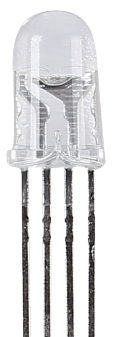
RGB LEDs can emit light in a wide range of colors. Each RGB LED combines three individual LEDs—red, green, and blue—encased in a transparent or semi-transparent plastic shell. By adjusting the input voltage to each of the three pins, different colors are produced through color mixing. In fact, this allows the RGB LED to generate up to 16,777,216 unique color combinations.
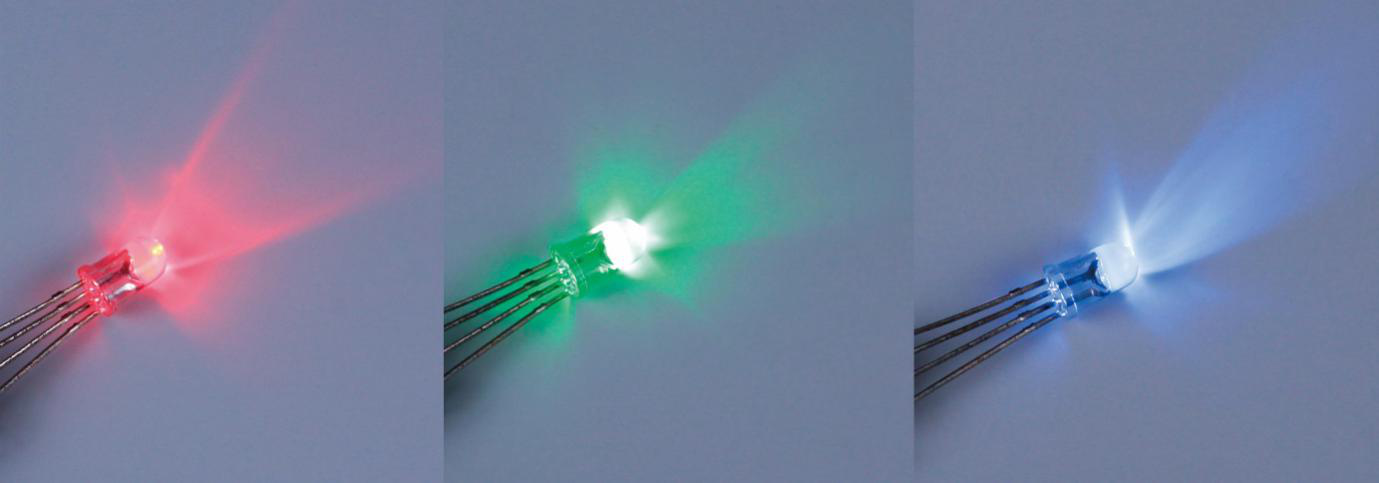
RGB LEDs can be categorized into common anode and common cathode ones. In this kit, the latter is used. The common cathode, or CC, means to connect the cathodes of the three LEDs. After you connect it with GND and plug in the three pins, the LED will flash the corresponding color.
Its circuit symbol is shown as figure.
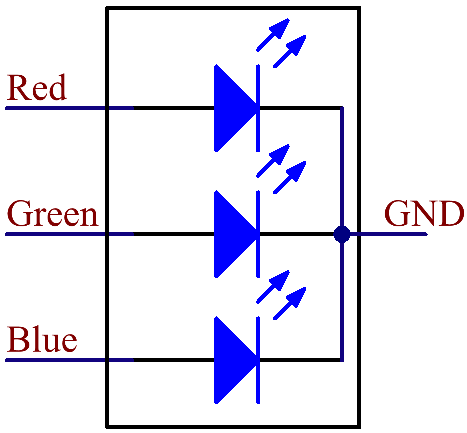
An RGB LED has 4 pins: the longest pin is the common cathode pin, which is usually connected to GND, the left pin next to the longest pin is Red, and the 2 pins on the right are Green and Blue.

Features
Color: Tri-Color (Red/Green/Blue)
Common Cathode
5mm Clear Round Lens
Forward Voltage: Red: DC 2.0 - 2.2V; Blue&Green: DC 3.0 - 3.2V (IF=20mA)
0.06 Watts DIP RGB LED
Luminance Brighter Up To +20%
Viewing Angle: 30°
Example
2.4 Colorful Light (For MicroPython User)
7.9 Building a Fruit Piano (For MicroPython User)
8.7 Setup a Web Server (For MicroPython User)
2.4 Colorful Light (For Arduino User)