Xmas Matrix
Note
🌟 Welcome to the SunFounder Facebook Community! Whether you’re into Raspberry Pi, Arduino, or ESP32, you’ll find inspiration, help ideas here.
✅ Be the first to get free learning resources.
✅ Stay updated on new products & exclusive giveaways.
✅ Share your creations and get real feedback.
Kit purchase
Looking for parts? Check out our all-in-one kits below — packed with components, beginner-friendly guides, and tons of fun.
Name |
Includes ESP32 board |
PURCHASE LINK |
|---|---|---|
ESP32 Ultimate Starter Kit |
ESP32 WROOM 32E + |
|
Universal Maker Sensor Kit |
Course Introduction
This project uses an Arduino Nano ESP32 and a MAX7219 8×8 LED matrix to display animated Christmas patterns with a smooth breathing-light effect.
Note
If this is your first time working with an Arduino project, we recommend downloading and reviewing the basic materials first.
Required Components
In this project, we need the following components:
SN |
COMPONENT INTRODUCTION |
QUANTITY |
PURCHASE LINK |
|---|---|---|---|
1 |
Arduino Nano ESP32 |
1 |
|
2 |
USB Type-C cable |
1 |
|
3 |
Breadboard |
1 |
|
4 |
Wires |
Several |
|
5 |
MAX7219 Dot Matrix Module |
1 |
Wiring
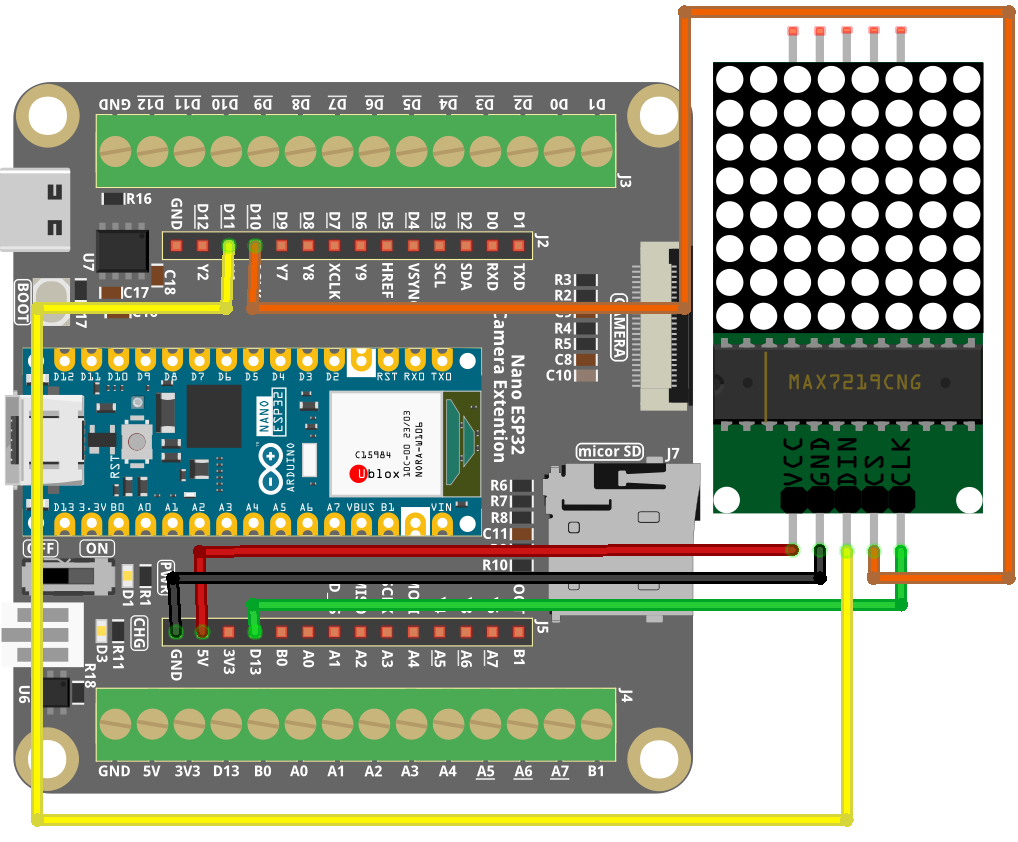
Common Connections:
MAX7219 Dot Matrix Module
CLK: Connect to D13 on the ESP32.
CS: Connect to D10 on the ESP32.
DIN: Connect to D11 on the ESP32.
GND: Connect to GND on the ESP32 Extension Board.
VCC: Connect to 5V on the ESP32 Extension Board.
Writing the Code
Note
You can copy this code into Arduino IDE.
Don’t forget to select the board(Arduino Nano ESP32) and the correct port before clicking the Upload button.
// Arduino Nano ESP32 - MAX7219 8x8 LED Matrix Christmas Animations
// - Compatible with ESP32 (no AVR-only LedControl library)
// - Uses a minimal MAX7219 bit-bang driver
// Wiring (same as your Nano ESP32 Tetris reference):
//   DIN -> D11
//   CS  -> D10
//   CLK -> D13

// -------------------- MAX7219 Pins (Nano ESP32) --------------------
#define DIN  11   // Data to MAX7219 DIN
#define CS   10   // Chip Select to MAX7219 CS/LOAD
#define CLK  13   // Clock to MAX7219 CLK

// -------------------- Minimal MAX7219 Driver (ESP32 compatible) --------------------
class MAX7219_8x8 {
public:
  MAX7219_8x8(int din, int clk, int cs) : _din(din), _clk(clk), _cs(cs) {}

  // Initialize MAX7219
  void begin(uint8_t intensity /*0..15*/) {
    pinMode(_din, OUTPUT);
    pinMode(_clk, OUTPUT);
    pinMode(_cs,  OUTPUT);

    digitalWrite(_cs, HIGH);
    digitalWrite(_clk, LOW);

    // MAX7219 setup
    sendCmd(0x0F, 0x00); // Display test: off
    sendCmd(0x09, 0x00); // Decode mode: none
    sendCmd(0x0B, 0x07); // Scan limit: 8 digits (0..7)
    sendCmd(0x0C, 0x01); // Shutdown: normal operation
    setIntensity(intensity);
    clear();
  }

  // Set brightness 0..15
  void setIntensity(uint8_t intensity) {
    if (intensity > 15) intensity = 15;
    sendCmd(0x0A, intensity);
  }

  // Clear display
  void clear() {
    for (int row = 0; row < 8; row++) setRow(row, 0x00);
  }

  // Set a row (row: 0..7), bits in data are columns (bit0 = col0)
  void setRow(uint8_t row, uint8_t data) {
    // MAX7219 digit registers are 1..8
    sendCmd(row + 1, data);
  }

  // Set a column (col: 0..7), bits in data are rows (bit0 = row0)
  // This matches LedControl's setColumn() behavior.
  void setColumn(uint8_t col, uint8_t data) {
    // Update internal buffer as rows, then write all rows.
    // For each row r, set/clear the bit at "col" based on data bit r.
    for (int r = 0; r < 8; r++) {
      bool on = (data >> r) & 0x01;
      if (on) _rowBuf[r] |=  (1 << col);
      else    _rowBuf[r] &= ~(1 << col);
    }
    // Push buffer to MAX7219
    for (int r = 0; r < 8; r++) setRow(r, _rowBuf[r]);
  }

  // Clear internal buffer + display (useful when using setColumn)
  void clearBuffered() {
    for (int r = 0; r < 8; r++) _rowBuf[r] = 0;
    clear();
  }

private:
  int _din, _clk, _cs;
  uint8_t _rowBuf[8] = {0};

  // Shift out 16 bits: register then data, MSB first
  void shiftOut16(uint8_t reg, uint8_t data) {
    for (int i = 7; i >= 0; i--) {
      digitalWrite(_clk, LOW);
      digitalWrite(_din, (reg >> i) & 1);
      digitalWrite(_clk, HIGH);
    }
    for (int i = 7; i >= 0; i--) {
      digitalWrite(_clk, LOW);
      digitalWrite(_din, (data >> i) & 1);
      digitalWrite(_clk, HIGH);
    }
    digitalWrite(_clk, LOW);
  }

  // Send one command to MAX7219
  void sendCmd(uint8_t reg, uint8_t data) {
    digitalWrite(_cs, LOW);
    shiftOut16(reg, data);
    digitalWrite(_cs, HIGH);
  }
};

MAX7219_8x8 lc(DIN, CLK, CS);

// -------------------- Patterns (8x8) --------------------
// Note: These patterns are the same as your original sketch.

byte treeBase[8] = {
  B00010000,
  B00111000,
  B01111100,
  B11111110,
  B00111000,
  B01111100,
  B11111110,
  B00111000
};

byte bellBase[8] = {
  B00000010,
  B00011100,
  B00111100,
  B11111100,
  B00111000,
  B01010000,
  B00010000,
  B00000000
};

byte bellMirror[8] = {
  B01000000,
  B00111000,
  B00111100,
  B00111111,
  B00011100,
  B00001010,
  B00001000,
  B00000000
};

byte hatBase[8] = {
  B00001100,
  B00011110,
  B00111101,
  B01111000,
  B01111000,
  B01111000,
  B11111100,
  B11111100
};

byte letterX[8] = {
  B10000001,
  B01000010,
  B00100100,
  B00011000,
  B00011000,
  B00100100,
  B01000010,
  B10000001
};

byte letterM[8] = {
  B10000001,
  B11000011,
  B10100101,
  B10011001,
  B10000001,
  B10000001,
  B10000001,
  B10000001
};

byte letterA[8] = {
  B00111100,
  B01100110,
  B11000011,
  B11000011,
  B11111111,
  B11000011,
  B11000011,
  B11000011
};

byte letterS[8] = {
  B00111110,
  B01100000,
  B01100000,
  B00111100,
  B00000110,
  B00000110,
  B01100110,
  B00111100
};

// -------------------- Display Helpers --------------------

// Display pattern using column writes (keeps your original orientation logic)
// The original code reversed the order: pattern[7 - i]
void displayPattern(const byte pattern[8]) {
  lc.clearBuffered(); // Clear matrix + internal buffer

  for (int col = 0; col < 8; col++) {
    // Write column data in reverse order for correct orientation
    lc.setColumn(col, pattern[7 - col]);
  }
}

// Breathing brightness effect
void displayWithBreathing(const byte pattern[8], int repeat) {
  for (int r = 0; r < repeat; r++) {
    for (int brightness = 0; brightness <= 15; brightness++) {
      lc.setIntensity((uint8_t)brightness); // Increase brightness
      displayPattern(pattern);
      delay(30);
    }
    for (int brightness = 15; brightness >= 0; brightness--) {
      lc.setIntensity((uint8_t)brightness); // Decrease brightness
      displayPattern(pattern);
      delay(30);
    }
  }
}

void setup() {
  // Initialize MAX7219
  lc.begin(15);     // Start with max intensity
  lc.clearBuffered();
}

void loop() {
  // Christmas tree breathing effect (twice)
  displayWithBreathing(treeBase, 2);

  // Bell breathing effect (original + mirrored)
  displayWithBreathing(bellBase, 1);
  displayWithBreathing(bellMirror, 1);

  // Christmas hat breathing effect (twice)
  displayWithBreathing(hatBase, 2);

  // Display "XMAS" breathing effect
  displayWithBreathing(letterX, 1);
  displayWithBreathing(letterM, 1);
  displayWithBreathing(letterA, 1);
  displayWithBreathing(letterS, 1);

  // Delay before repeating
  delay(500);
}