Water Level 2.0
Note
🌟 Welcome to the SunFounder Facebook Community! Whether you’re into Raspberry Pi, Arduino, or ESP32, you’ll find inspiration, help ideas here.
✅ Be the first to get free learning resources.
✅ Stay updated on new products & exclusive giveaways.
✅ Share your creations and get real feedback.
Kit purchase
Looking for parts? Check out our all-in-one kits below — packed with components, beginner-friendly guides, and tons of fun.
Name |
Includes ESP32 board |
PURCHASE LINK |
|---|---|---|
ESP32 Ultimate Starter Kit |
ESP32 WROOM 32E + |
|
Universal Maker Sensor Kit |
Course Introduction
In this lesson, you’ll learn how to build a simple water level indicator using an analog water level sensor and 8 LEDs with the Arduino Nano ESP32.
As the water level rises, more LEDs light up to visually display the current level in real time.
Note
If this is your first time working with an ESP32 project, we recommend downloading and reviewing the basic materials first.
Required Components
In this project, we need the following components:
SN |
COMPONENT INTRODUCTION |
QUANTITY |
PURCHASE LINK |
|---|---|---|---|
1 |
Arduino Nano ESP32 |
1 |
|
2 |
USB Cable |
1 |
|
3 |
Breadboard |
1 |
|
4 |
Wires |
Several |
|
5 |
Water Level Detection Module |
1 |
|
6 |
Resistor |
1KΩ |
|
7 |
LED |
Several |
Wiring
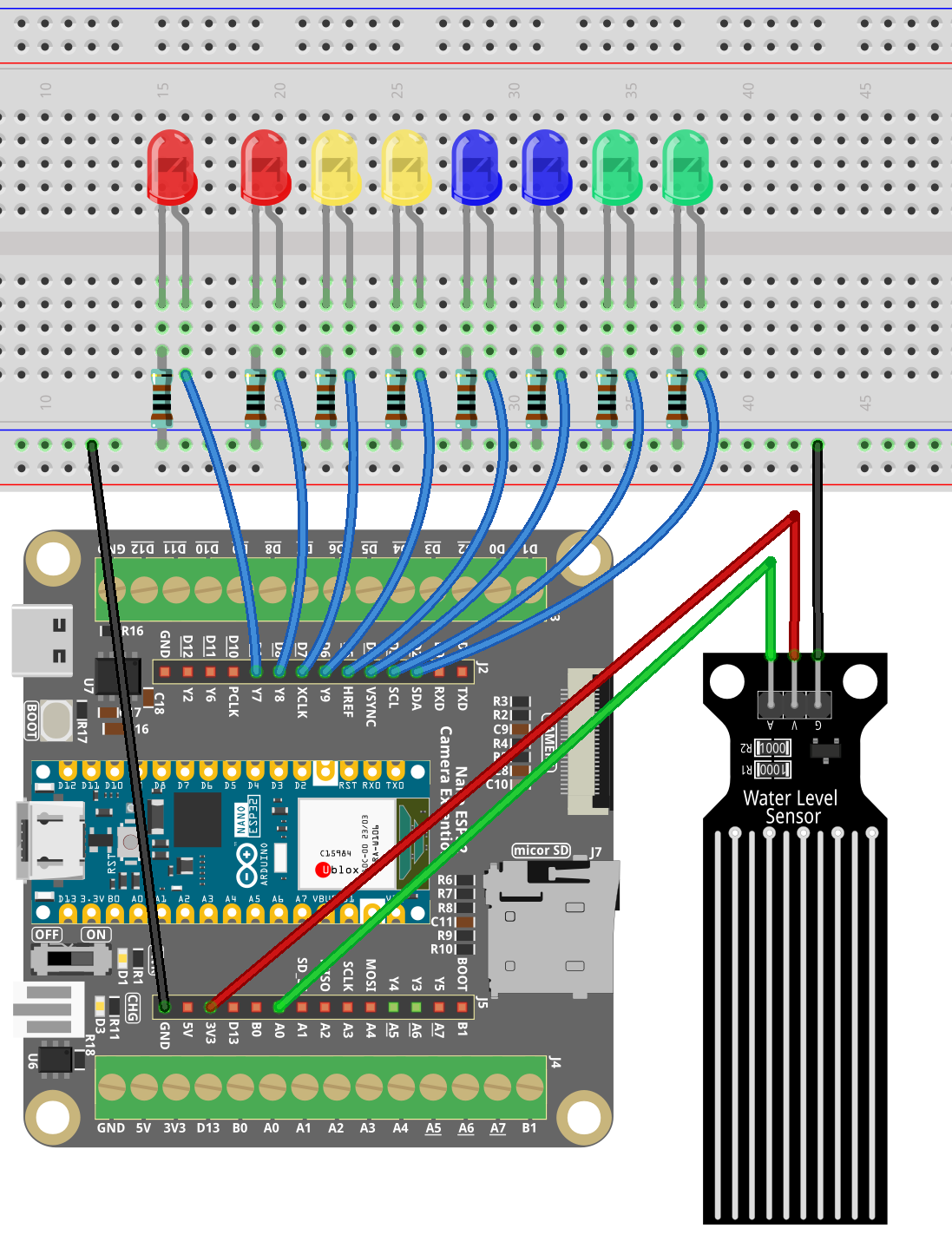
Common Connections:
Water Level Detection Module
A: Connect to A0 on the ESP32.
G: Connect to breadboard’s negative power bus.
V: Connect to 3.3V on the ESP32 Extension Board.
LEDS
Connect the LED cathode to a 1KΩ resistor then to the negative power bus on the breadboard, and the anode to the D2~D9 on the ESP32.
Writing the Code
Note
You can copy this code into Arduino IDE.
Don’t forget to select the board(Arduino Nano ESP32) and the correct port before clicking the Upload button.
// LED pin array (Dx labels for Arduino Nano ESP32)
const int ledPins[] = {D2, D3, D4, D5, D6, D7, D8, D9};
const int numLEDs = 8;

// Water level sensor analog input pin
// Use an ADC-capable pin on ESP32
const int sensorPin = A0;   // On Nano ESP32, A0 is mapped to a valid ADC pin

void setup() {
  Serial.begin(115200);

  // Set all LED pins as output
  for (int i = 0; i < numLEDs; i++) {
    pinMode(ledPins[i], OUTPUT);
    digitalWrite(ledPins[i], LOW);
  }
}

void loop() {
  // Read the water level sensor value (ESP32 ADC range: 0~4095)
  int sensorValue = analogRead(sensorPin);

  Serial.print("Water level analog value: ");
  Serial.println(sensorValue);

  // Map the analog value to number of LEDs (0~8)
  // Adjust 0~1900 according to your actual sensor output range
  int level = map(sensorValue, 0, 1900, 0, numLEDs);
  level = constrain(level, 0, numLEDs);

  // Turn on LEDs according to the water level
  for (int i = 0; i < numLEDs; i++) {
    if (i < level) {
      digitalWrite(ledPins[i], HIGH);
    } else {
      digitalWrite(ledPins[i], LOW);
    }
  }

  delay(500);  // Delay before next update
}