Note
Hello, welcome to the SunFounder Raspberry Pi & Arduino & ESP32 Enthusiasts Community on Facebook! Dive deeper into Raspberry Pi, Arduino, and ESP32 with fellow enthusiasts.
Why Join?
Expert Support: Solve post-sale issues and technical challenges with help from our community and team.
Learn & Share: Exchange tips and tutorials to enhance your skills.
Exclusive Previews: Get early access to new product announcements and sneak peeks.
Special Discounts: Enjoy exclusive discounts on our newest products.
Festive Promotions and Giveaways: Take part in giveaways and holiday promotions.
👉 Ready to explore and create with us? Click [here] and join today!
2.2.7 MFRC522 RFID Module
Introduction
Radio Frequency Identification (RFID) refers to technologies that use wireless communication between an object (or tag) and interrogating device (or reader) to automatically track and identify such objects.
Some of the most common applications for this technology include retail supply chains, military supply chains, automated payment methods, baggage tracking and management, document tracking and pharmaceutical management, to name a few.
In this project, we will use RFID for reading and writing.
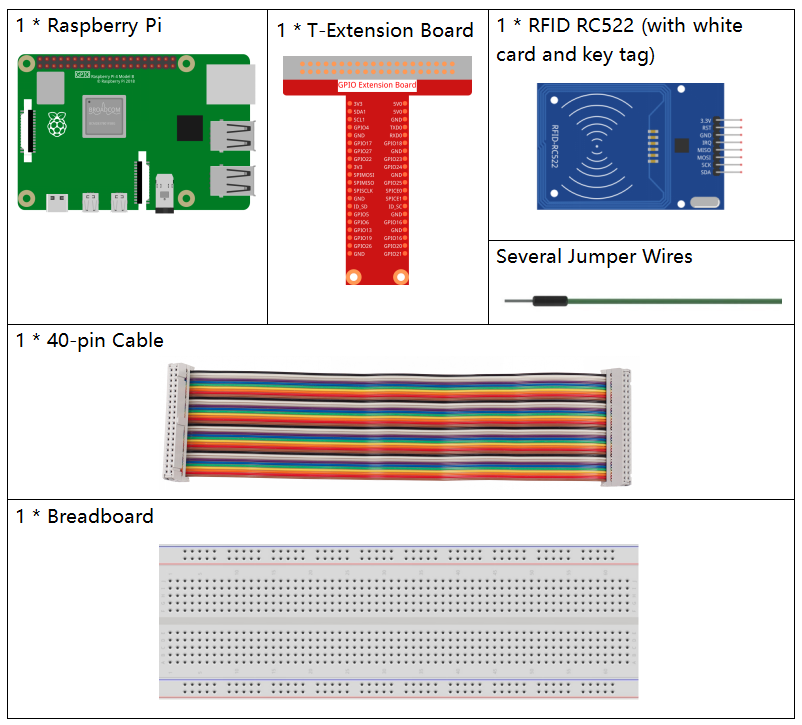
Components
Principle
RFID
Radio Frequency Identification (RFID) refers to technologies that involve using wireless communication between an object (or tag) and an interrogating device (or reader) to automatically track and identify such objects. The tag transmission range is limited to several meters from the reader. A clear line of sight between the reader and tag is not necessarily required.
Most tags contain at least one integrated circuit (IC) and an antenna. The microchip stores information and is responsible for managing the radio frequency (RF) communication with the reader. Passive tags do not have an independent energy source and depend on an external electromagnetic signal, provided by the reader, to power their operations. Active tags contain an independent energy source, such as a battery. Thus, they may have increased processing, transmission capabilities and range.
MFRC522
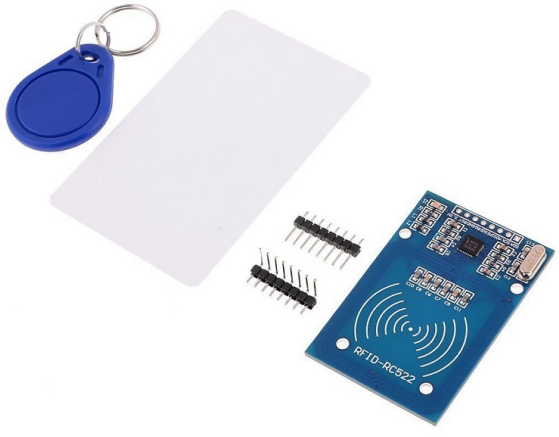
MFRC522 is a kind of integrated read and write card chip. It is commonly used in the radio at 13.56MHz. Launched by the NXP Company, it is a low-voltage, low-cost, and small-sized non-contact card chip, a best choice of intelligent instrument and portable handheld device.
The MF RC522 uses advanced modulation and demodulation concept which fully presented in all types of 13.56MHz passive contactless communication methods and protocols. In addition, it supports rapid CRYPTO1 encryption algorithm to verify MIFARE products. MFRC522 also supports MIFARE series of high-speed non-contact communication, with a two-way data transmission rate up to 424kbit/s. As a new member of the 13.56MHz highly integrated reader card series, MF RC522 is much similar to the existing MF RC500 and MF RC530 but there also exists great differences. It communicates with the host machine via the serial manner which needs less wiring. You can choose between SPI, I2C and serial UART mode (similar to RS232), which helps reduce the connection, save PCB board space (smaller size), and reduce cost.
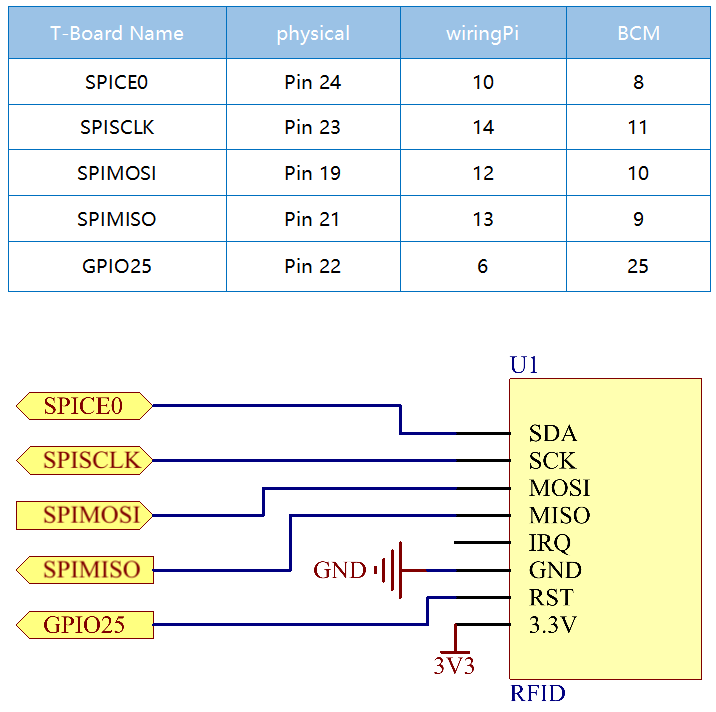
Schematic Diagram
Experimental Procedures
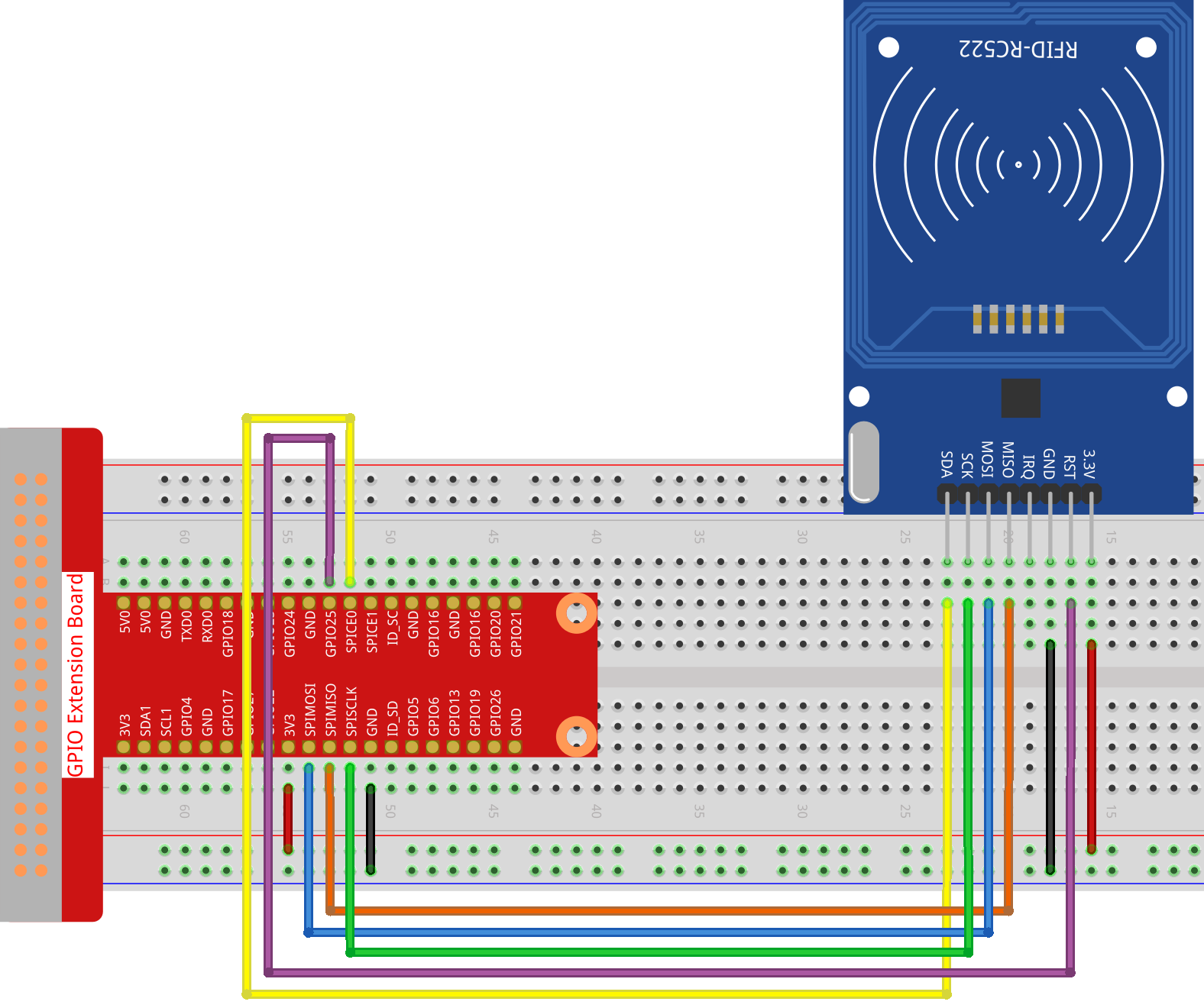
Step 1: Build the circuit.
Step 2: Set up SPI (refer to SPI Configuration for more details. If you have set SPI, skip this step.)
Step 3: Go to the folder of the code.
cd ~/davinci-kit-for-raspberry-pi/c/2.2.7/
Step 4: Compile the code.
make read
make write
Note
There are two examples for you to read or write the card ID, and you can choose one of them according to your need.
Step 5: After running ./write, enter the information, such as the name of the person, and then put the tag or card on the MRC522 module and wait for the writing to be completed.
sudo ./write
Step 6: Now run ./read to read the information of the tag or card you have written.
sudo ./read
Note
If it does not work after running, or there is an error prompt: "wiringPi.h: No such file or directory", please refer to Install and Check the WiringPi.
Code Explanation
InitRc522();
This function is used to initialize the RFID RC522 module.
uint8_t read_card_data();
This function is used to read the data of the card, and if the read is successful, it will return “1”.
uint8_t write_card_data(uint8_t *data);
This function is used to write the data of card and returns “1” if the write is successful. *data is the information that will be written to the card.