Note
Hello, welcome to the SunFounder Raspberry Pi & Arduino & ESP32 Enthusiasts Community on Facebook! Dive deeper into Raspberry Pi, Arduino, and ESP32 with fellow enthusiasts.
Why Join?
Expert Support: Solve post-sale issues and technical challenges with help from our community and team.
Learn & Share: Exchange tips and tutorials to enhance your skills.
Exclusive Previews: Get early access to new product announcements and sneak peeks.
Special Discounts: Enjoy exclusive discounts on our newest products.
Festive Promotions and Giveaways: Take part in giveaways and holiday promotions.
👉 Ready to explore and create with us? Click [here] and join today!
LUMI Piano
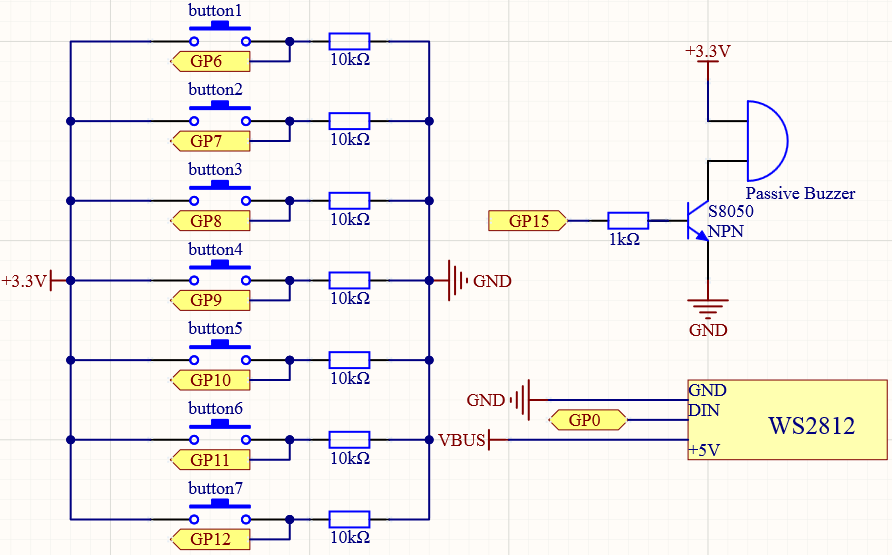
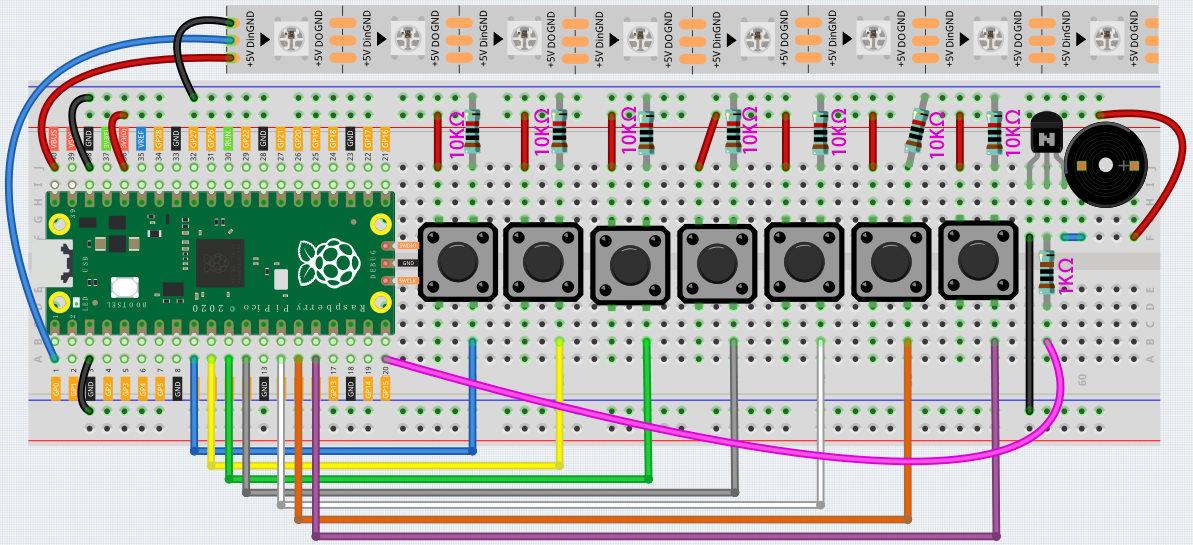
In this project, we will use 7 buttons, a WS2812 Strip and a buzzer to create a LUMI Piano.
The 7 buttons respectively represent 7 notes. When the button is pressed, the passive buzzer will emit the corresponding note, and the WS2812 Strip will light up the corresponding LED.
Schematic
Wiring
Code
After the program is running, press different buttons, the buzzer will emit different sounds, and the WS2812 will also light up the corresponding LEDs.
How it works?
const int buttonPin[] = {6, 7, 8, 9, 10, 11, 12};

const int pitch[] = {523, 587, 659, 698, 784, 880, 988};
Store the 8 button pins in the array buttonPin[] so that they can be quickly set and used later.
pitch[] stores the frequencies corresponding to C, E, E, F, G, A, B,notes in C major scale.
for (int i = 0; i <  NUMPIXELS ; i++) {
  pinMode(buttonPin[i], OUTPUT);
}
pixels.begin();
pinMode(buzzerPin, OUTPUT);
Serial.begin(9600);
Use the for loop in setup() to initialize the pins of all buttons and buzzer and set them to output mode.
for (int i = 0; i < NUMPIXELS; i++) {
  if (digitalRead(buttonPin[i]) == HIGH) {
    tone(buzzerPin, pitch[i]);
    pixels.setBrightness(100);
    pixels.setPixelColor(i, 0xFF8822);
    pixels.show();
    while (digitalRead(buttonPin[i]) == HIGH);
    fade();
    noTone(buzzerPin);
  }
}
Create a for loop in loop() function to traverse all the buttons, sounds and pixels, and set the judgment when the button is pressed, the buzzer will sound the corresponding note, and the WS2812 will light up the corresponding LED.
void fade() {
  while (1) {
    int brightness = pixels.getBrightness();
    if (brightness <= 0) {
      return;
    }
    pixels.setBrightness(brightness -= 1);
    pixels.show();
    delay(2);
  }
The fade() function is used to slowly reduce the brightness of the LEDs on the WS2812 Strip to 0.
First get the brightness value of the currently lit LED through getBrightness() function, then write the decreasing brightness value to WS2812 Strip through setBrightness() function, and finally present the effect through show() function.
If the brightness is less than 0, then exit this function.