Note
Welcome to the SunFounder Raspberry Pi, Arduino & ESP32 Community on Facebook!
Get technical support and troubleshooting help.
Learn and share projects, tips, and tutorials.
Access early product previews and updates.
Enjoy exclusive discounts and giveaways.
👉 Join us here: [here]
FAQ
Quick Troubleshooting
Power button not working → Power Button Not Working?
OLED screen not working → OLED Screen Not Working?
RGB LEDs not working → RGB LEDs Not Working?
Fan not working → Fan Not Working / Cannot Be Controlled?
Dashboard shows no data → The Dashboard Shows No Data
NVMe SSD not detected → NVMe PIP Module Not Working?
NVMe SSD detected but causes system restart → NVMe SSD Detected but Causes System Restart on Read/Write?
PI5 fails to boot → PI5 Fails to Boot (Red LED)?
1. Hardware
Compatible Systems
Systems that passed testing on the Raspberry Pi 5:

Power Button
The power button extends the original Raspberry Pi 5 power button and behaves similarly.
Briefly press: Power on / wake OLED / switch OLED pages.
Hold for 2 seconds: Safe shutdown (requires 1. Configuring Shutdown to Deactivate GPIO Power).
Hold for 5 seconds: Force shutdown.

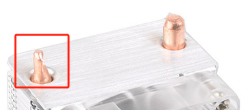
Copper Pipe Ends on the Tower Cooler
The flattened ends of the U-shaped copper heat pipes are part of the normal manufacturing process and are designed to allow the heat pipes to pass through the aluminum fins.
Raspberry Pi AI HAT+
The Raspberry Pi AI HAT+ is not compatible with the Pironman 5 Pro MAX.

The Raspberry Pi AI Kit combines the Raspberry Pi M.2 HAT+ and the Hailo AI accelerator module.

You can detach the Hailo AI accelerator module from the Raspberry Pi AI Kit and directly insert it into the NVMe PIP module of the Pironman 5 Pro MAX.
4.3-Inch Screen Is Black / Not Displaying?
The 4.3-inch DSI screen is plug-and-play — no additional driver installation is required.
Note
The ON/AUTO jumper on the HDMI/USB board only controls the speaker audio output. It has no effect on the screen display.
If the screen is black or not displaying, check the following:
Ensure the DSI ribbon cable is connected to the correct DSI port on the Raspberry Pi 5.
Check that the ribbon cable is fully inserted, the clamp is pressed down firmly, and the contacts are facing the correct direction.
Run the following command to confirm whether the system detects the DSI screen:
sudo dmesg | grep -i dsi
If the screen is detected, you should see output similar to
DSI display found. If there is no output, the screen is not being recognized — recheck the physical connection.
External HDMI Screen — Taskbar Only Appears on the 4.3-Inch Screen?
When you connect an external HDMI monitor to the Pironman 5 Pro MAX, the desktop taskbar may stay on the built-in 4.3-inch DSI screen instead of moving to the external display. That is because the system defaults to the DSI screen as the primary display.
If you want to set the HDMI monitor as the primary screen at startup:
Create a startup script:
sudo nano /usr/local/bin/fix-primary-screen.sh
Add the following content to the script:
#!/bin/bash
# Check if an external HDMI monitor is connected
if wlr-randr | grep -q "HDMI-A-1"; then
    # Turn off the DSI screen first
    wlr-randr --output DSI-1 --off
    sleep 2
    # Re-enable DSI and place it to the right of HDMI
    wlr-randr --output DSI-1 --on --right-of HDMI-A-1
fi
Make the script executable:
sudo chmod +x /usr/local/bin/fix-primary-screen.sh
Add the script to autostart. Edit the labwc autostart file:
nano ~/.config/labwc/autostartAdd the following line (the
&runs it in the background):/usr/local/bin/fix-primary-screen.sh &
2. Cooling and Fans
Fan Not Working / Cannot Be Controlled?
The Pro MAX adopts the official Raspberry Pi PWM fan control solution. All three cooling fans are directly controlled by the Raspberry Pi system and do not rely on the pironman5 service (therefore, you will not see fan control options in the command-line tool or the Dashboard).
The CPU fan on the Pironman 5 is controlled by the Raspberry Pi system. The CPU fan speed depends on the Raspberry Pi 5 CPU temperature.
Default CPU fan curve:
< 50°C: Off (0%)
50°C+: Low speed (30%)
60°C+: Medium speed (50%)
67.5°C+: High speed (70%)
75°C+: Full speed (100%)
Check the current CPU temperature (example output: temp=48.7'C):
vcgencmd measure_temp
You can manually control the CPU fan using the following commands:
pinctrl FAN_PWM op dl   # Enable fan (low active)
pinctrl FAN_PWM op dh   # Disable fan (high active)
pinctrl FAN_PWM a0      # Auto mode
You can also adjust the CPU fan temperature thresholds by editing:
nano /boot/firmware/config.txt
Add:
dtparam=cooling_fan=on
dtparam=fan_temp0=40000
dtparam=fan_temp0_hyst=10000
dtparam=fan_temp0_speed=125
This configuration starts the CPU fan at 40°C with PWM speed level 125.
After saving the file, reboot the Raspberry Pi for the changes to take effect.
Dashboard Does Not Show Fan Speed?
The Pro MAX uses custom 5-pin fans with the following pinout: PWM / 5V / GND / RGB Data In / RGB Data Out.
These fans do not have a tachometer (speed feedback) pin, so the system cannot read the actual RPM. The Dashboard not showing fan speed is expected and normal.
Fan speed is controlled by the Raspberry Pi’s native PWM temperature curve:
< 50°C: Off (0%)
50°C+: Low speed (30%)
60°C+: Medium speed (50%)
67.5°C+: High speed (70%)
75°C+: Full speed (100%)
3. OLED and RGB
OLED Screen Not Working?
If the OLED screen is not displaying or displaying incorrectly, follow these troubleshooting steps:
Ensure the FPC cable of the OLED screen is securely connected. It is recommended to reconnect the OLED screen and then power on the device.
Confirm that the Raspberry Pi is running a supported operating system.
See Compatible Systems.
When the OLED screen is powered on for the first time, it may only display pixel blocks. You need to follow the instructions in Set Up on Raspberry Pi/Ubuntu/Kali/Homebridge OS to complete the configuration before it can display proper information.
Use the following command to check if the OLED I2C address
0x3Cis detected:sudo i2cdetect -y 1
If the I2C address
0x3Cis detected, restart the Pironman 5 service:sudo systemctl restart pironman5.service
If the address is not detected, enable I2C:
sudo nano /boot/firmware/config.txt
Add:
dtparam=i2c_arm=on
Save the file and reboot the Raspberry Pi.
If the issue still persists, please send us the following log file:
cat /var/log/pironman5/pironman5.log
How to Customize the OLED Display?
If you want to customize the OLED display, such as adding custom 2–4 digit image displays, you can modify the OLED page files in one of the following ways.
Method 1: Modify the Installed Files Directly
List the OLED page files:
ls /opt/pironman5/venv/lib/python3.13/site-packages/pm_auto/addons/oled/pages/Modify the desired Python files.
Restart the service to apply the changes:
sudo systemctl restart pironman5.service
Method 2: Clone and Reinstall ``pm_auto``
Clone the
pm_autorepository:git clone -b 1.4.x https://github.com/sunfounder/pm_auto/
After making changes, reinstall the modified package:
sudo /opt/pironman5/venv/bin/pip3 uninstall pm_auto -y && \
sudo /opt/pironman5/venv/bin/pip3 install ~/pm_auto --no-build-isolation && \
sudo chown -R pironman5:pironman5 /opt/pironman5
Restart the service:
sudo systemctl restart pironman5.service
Testing and Debugging
To view runtime logs:
journalctl -xefu pironman5.service
You can also stop the service and run it manually for faster testing:
sudo systemctl stop pironman5.service
sudo pironman5 start
RGB LEDs Not Working?
The two pins on the expansion board are used to connect the RGB LEDs to GPIO10. Ensure that the jumper cap on these two pins is properly installed.

Confirm that the Raspberry Pi is running a supported operating system.
See Compatible Systems.
Run the following command to enable SPI:
sudo raspi-configNavigate to:
3 Interfacing Options→I3 SPI→YESThen reboot the Raspberry Pi.
If the issue still persists, please send us the following log file:
cat /var/log/pironman5/pironman5.log
How to Wake Up the OLED Screen
To save power and extend the screen’s lifespan, the OLED screen will automatically turn off after a period of inactivity. This is part of the normal design and does not affect the product’s functionality.
Note
For OLED Screen configuration (such as turn ON/OFF, sleeptime, rotation, etc), please refer to View and Control from Dashboard or Control with Commands.
4. Dashboard and Software
The Dashboard Shows No Data
If the Dashboard shows no data, first open the Dashboard Log page and check whether there are any error messages related to influxdb.
Common errors include:
database not foundfailed to connect to influxdbconnection refusedtimeout
You can try the following steps to resolve the issue.
Clear your browser cache, or reopen the Dashboard page using Incognito / Private mode.
Check whether the following services are running properly:
sudo systemctl status pironman5 --no-pager
sudo systemctl status influxdb --no-pager
Both services should display:
active (running)
If either service is not running properly, restart them:
sudo systemctl restart influxdb
sudo systemctl restart pironman5
Then wait about 30 seconds and refresh the Dashboard page.
Check whether the
pironman5database exists:influx
Then run:
SHOW DATABASES;
You should see:
pironman5
_internal
If the database is missing or corrupted, you can try clearing the historical data from the Dashboard using:
Settings → Clear All DataIf the issue still persists after trying all the above steps, we recommend reinstalling the Raspberry Pi OS and Pironman 5 software.
How to Disable the Web Dashboard
Once you have completed the installation of the pironman5 module, you will be able to access the View and Control from Dashboard.
If you do not need this feature and want to reduce CPU and RAM usage, you can disable the dashboard during installation by adding the --disable-dashboard flag.
cd ~/pironman5
sudo python3 install.py --disable-dashboard
If you have already installed pironman5, you can remove the Dashboard module and influxdb:
/opt/pironman5/venv/bin/pip3 uninstall pm-dashboard influxdb
sudo apt purge influxdb
sudo systemctl restart pironman5
How to Uninstall and Reinstall the Pironman 5 Software
Uninstall the current
pironman5software:cd ~/pironman5 sudo python3 install.py --uninstall
Reboot the Raspberry Pi as prompted, then remove the
pironman5directory:cd ~/ sudo rm -rf pironman5
Run the following command to reinstall the software for your Pironman 5 model:
curl -sSL "https://raw.githubusercontent.com/sunfounder/pironman5/v1/install.sh" | sudo bash
How to Control Components Using the pironman5 Command
You can refer to the following tutorial to control the components of the Pironman 5 series using the pironman5 command.
pip install piper-tts Fails with “Could Not Find a Version”?
When installing sunfounder-voice-assistant on the Pironman 5 Pro MAX, you may encounter the following error:
ERROR: Could not find a version that satisfies the requirement piper-tts==1.3.0
ERROR: No matching distribution found for piper-tts==1.3.0
This error occurs because piper-tts 1.3.0 only provides 64-bit (aarch64) wheels. If your Raspberry Pi is running a 32-bit operating system, pip cannot find a compatible package.
Solution: Install a 64-bit version of Raspberry Pi OS.
Check your current system architecture:
uname -maarch64→ 64-bit (no issue)armv7l→ 32-bit (needs upgrade)
Use Raspberry Pi Imager to flash a 64-bit Raspberry Pi OS image onto your storage device.
After installing the 64-bit OS, reinstall the
pironman5software andsunfounder-voice-assistant.
5. Boot and Storage
PI5 Fails to Boot (Red LED)?
This issue may be caused by a system update, changes to the boot order, or a corrupted bootloader. You can try the following steps to resolve the problem:
Check USB-HDMI Adapter Connection
Please carefully check whether the USB-HDMI adapter is securely connected to the PI5.
Try unplugging and reconnecting the USB-HDMI adapter.
Then reconnect the power supply and check if the PI5 boots successfully.
Test PI5 Outside the Case
If reconnecting the adapter does not solve the problem:
Remove the PI5 from the Pironman 5 series case.
Power the PI5 directly with the power adapter (without the case).
Check if it can boot normally.
Restore the Bootloader
If the PI5 still cannot boot, the bootloader may be corrupted. You can follow this guide: 2. Update the Bootloader and choose whether to boot from SD card or NVMe/USB.
Insert the prepared SD card into the PI5, power it on, and wait at least 10 seconds. Once the recovery is complete, remove and reformat the SD card.
Then use Raspberry Pi Imager to flash the latest Raspberry Pi OS and try booting again.
NVMe PIP Module Not Working?
Confirm that your NVMe SSD is compatible. Refer to the compatible NVMe SSD list for verified, stable, and compatible drives.
Ensure the FPC cable connecting the NVMe PIP module to the Raspberry Pi 5 is securely attached.
Confirm that your SSD is properly secured to the NVMe PIP module.
Check the status of the NVMe PIP Module’s LEDs:
After confirming all connections, power on the device and observe the two indicators on the NVMe PIP Module:
PWR LED: Should be lit.
STA LED: Should blink to indicate normal operation.
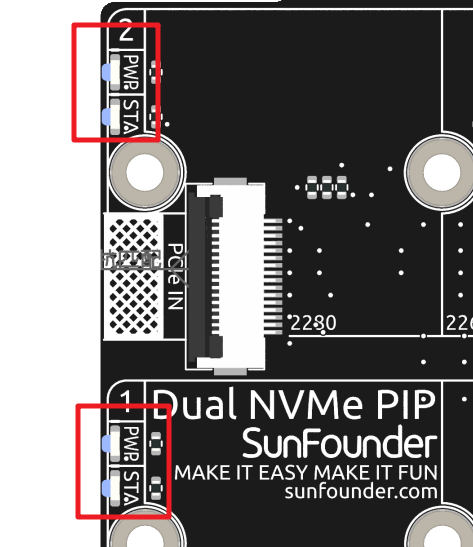
If the PWR LED is on but the STA LED is not blinking, it indicates the NVMe SSD is not recognized by the Raspberry Pi.
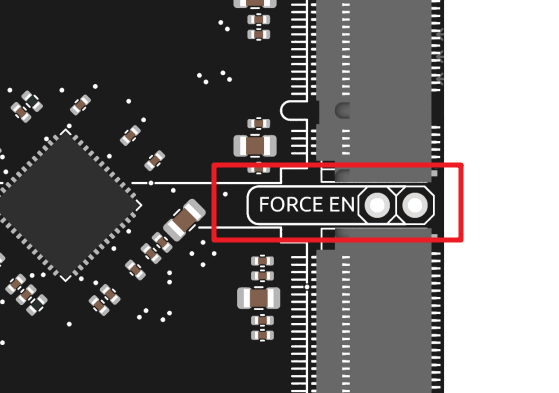
If the PWR LED is off, short the “Force Enable” pins on the module. If the PWR LED lights up, it could indicate a loose FPC cable or unsupported system configuration for NVMe.
Confirm that your NVMe SSD has a properly installed operating system. Refer to 3. Installing the Operating System.
If the wiring is correct and the OS is installed, but the NVMe SSD still fails to boot, try booting from a Micro SD card to verify the functionality of other components. Once confirmed, proceed to 3. Configure boot from the SSD.
If the problem persists after performing the above steps, please send an email to service@sunfounder.com. We will respond as soon as possible.
NVMe SSD Detected but Causes System Restart on Read/Write?
In some cases (especially with the WD Blue SN5000), the NVMe SSD may be detected by the Raspberry Pi 5 but cause the system to restart during read/write operations. This is a PCIe compatibility/stability issue between the SSD and the Raspberry Pi 5, not a Pironman 5 hardware fault.
Try the following steps to resolve the issue:
Update the Raspberry Pi 5 bootloader to the latest version:
sudo rpi-eeprom-update -a
sudo reboot
Force PCIe Gen3 speed by adding the following line to
/boot/firmware/config.txt:dtparam=pciex1_gen=3
Disable ASPM (Active State Power Management) by adding
pcie_aspm=offto the kernel command line. Edit/boot/firmware/cmdline.txtand append it to the existing line (do not create a new line):pcie_aspm=off
Note
pcie_aspm=offis often the critical fix — PCIe ASPM issues are very common on the Raspberry Pi 5 and can cause NVMe drives to randomly disconnect or restart the system during heavy I/O.After applying the above changes, reboot the Raspberry Pi:
sudo rebootIf the issue persists, repartition and reformat the NVMe SSD, then reinstall the operating system.
How to Change the Raspberry Pi Boot Order Using Commands
If you are already logged into your Raspberry Pi, you can change the boot order using commands.
How to Modify the Boot Order with Raspberry Pi Imager
In addition to modifying the BOOT_ORDER in the EEPROM configuration, you can also use Raspberry Pi Imager to change the boot order.
How to Copy the System from the SD Card to an NVMe SSD
If you do not have an NVMe-to-USB adapter, you can first install the system onto a Micro SD card, then copy the system to the NVMe SSD after booting successfully.
6. Advanced Usage
How to Remove the Protective Film
Two acrylic panels are included in the package, both covered with yellow/transparent protective film on both sides to prevent scratches.
The protective film may be difficult to remove. Use a screwdriver to gently lift one corner, then carefully peel off the entire film.

How to Install OpenSSH via Powershell?
When you use ssh <username>@<hostname>.local (or ssh <username>@<IP address>) to connect to your Raspberry Pi, but the following error message appears.
ssh: The term 'ssh' is not recognized as the name of a cmdlet, function, script file, or operable program. Check the
spelling of the name, or if a path was included, verify that the path is correct and try again.
It means your computer system is too old and does not have OpenSSH pre-installed, you need to follow the tutorial below to install it manually.
Type
powershellin the search box of your Windows desktop, right click on theWindows PowerShell, and selectRun as administratorfrom the menu that appears.
Use the following command to install
OpenSSH.Client.Add-WindowsCapability -Online -Name OpenSSH.Client~~~~0.0.1.0
After installation, the following output will be returned.
Path          :
Online        : True
RestartNeeded : False
Verify the installation by using the following command.
Get-WindowsCapability -Online | Where-Object Name -like 'OpenSSH*'
It now tells you that
OpenSSH.Clienthas been successfully installed.Name : OpenSSH.Client~~~~0.0.1.0 State : Installed Name : OpenSSH.Server~~~~0.0.1.0 State : NotPresent
Warning
If the above prompt does not appear, it means that your Windows system is still too old, and you are advised to install a third-party SSH tool, like PuTTY.
Now restart PowerShell and continue to run it as administrator. At this point you will be able to log in to your Raspberry Pi using the
sshcommand, where you will be prompted to enter the password you set up earlier.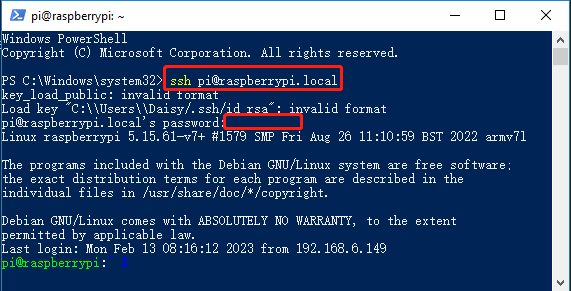
If I Set Up OMV, Can I Still Use the Pironman5’s Function?
Yes, OpenMediaVault is set up on the Raspberry Pi system. Please follow the steps of Set Up on Raspberry Pi/Ubuntu/Kali/Homebridge OS to continue the configuration.
Raspberry Pi Camera Not Working?
When the camera is not working, 90% of the issues are related to the ribbon cable connection or the camera hardware itself.
First, use rpicam-hello --list-cameras to confirm whether the camera is detected. If it is successfully detected, you should see a message similar to the following:
Available cameras
-----------------
0 : ov5647 [2592x1944] (/base/axi/pcie@1000120000/rp1/i2c@88000/ov5647@36)
If the camera is not detected, check whether the ribbon cable is reversed or not fully inserted. If the issue persists, try replacing the ribbon cable or the camera module for cross-testing.
Can I Install Home Assistant OS on the Pironman 5 Pro MAX?
The Pironman 5 Pro MAX does not have its own dedicated Home Assistant add-on. However, you can use the Pironman 5 MAX add-on instead — follow the SunFounder add-ons repository guide.
Be aware of the following limitations:
4.3-inch screen: Home Assistant OS is a lite system without a desktop environment. The 4.3-inch screen built into the Pro MAX will not display anything.
NVMe PIP dual SSDs: Home Assistant OS cannot read both NVMe SSDs on the Pro MAX’s dual NVMe PIP module.
OLED screen and RGB LEDs: These components work normally after installing the add-on — no additional configuration is required.
CPU fan: The CPU fan requires manual configuration to work under Home Assistant OS. Add the following to
/boot/firmware/config.txt:dtparam=cooling_fan=on dtparam=fan_temp0=40000 dtparam=fan_temp0_hyst=10000 dtparam=fan_temp0_speed=125
After saving and rebooting, the CPU fan will be controlled by the Raspberry Pi system based on CPU temperature. You can also control it manually via
pinctrlcommands — see Fan Not Working / Cannot Be Controlled?.